How to Measure Shoulder Width: Complete Guide for Men & Women
Getting an accurate shoulder measurement is important for choosing the right clothing size, tailoring garments, tracking body proportions, and using body shape calculators. This guide explains exactly where to measure your shoulders, how to measure them step by step, and the common mistakes that can affect your results.
Use Your Shoulder Measurement
Combine your bust, waist, hip, shoulder, height, and weight measurements with our free Body Measurement Calculator to get a clearer picture of your overall proportions.
✓ Supports inches and centimeters
Different Types of Shoulder Measurements
Shoulder measurements aren’t all taken the same way. The correct method depends on whether you’re measuring for clothing, tailoring, fitness, or body shape analysis. Here are the three most common types.
Shoulder Width
Shoulder width is the straight-line distance from one shoulder point (acromion bone) to the other. It’s the standard measurement used for body shape calculators, clothing sizes, jackets, dresses, and general body proportion analysis.
Across Shoulders
The across shoulder measurement follows the natural curve across the upper back from one shoulder point to the other instead of measuring in a straight line. Tailors commonly use this measurement when making suits, jackets, coats, and custom shirts because it provides a better fit across the back.
Shoulder Circumference
Shoulder circumference measures all the way around the shoulders and upper chest. While it’s less common for everyday clothing, it’s sometimes used for compression wear, protective equipment, sports gear, and certain fitness assessments.
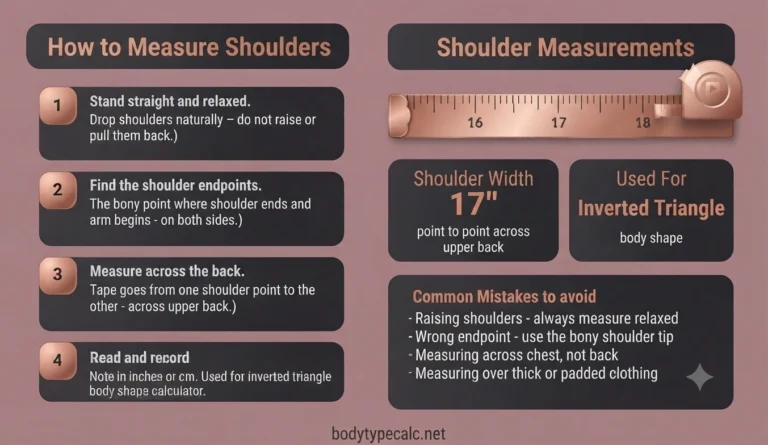
How to Measure Shoulder Width Correctly
Measuring your shoulder width only takes a minute when you follow the correct method. A flexible measuring tape and a mirror, or help from another person, will give the most accurate result.
Step 1: Wear fitted clothing
Wear a thin T-shirt, tank top, or fitted top so your shoulder bones are easy to locate. Avoid hoodies, jackets, or bulky clothing that can make your shoulders appear wider.
Step 2: Find the shoulder points
Find the outer edge of each shoulder bone (acromion) where your shoulder meets your upper arm. These two points are where you’ll start and finish the measurement.
Step 3: Measure from shoulder to shoulder
Using a flexible measuring tape, measure in a straight line across your upper back from one shoulder point to the other. Keep the tape flat without wrapping it around your shoulders.
Step 4: Stand in a Natural Position
Stand upright with your shoulders relaxed and your arms resting naturally at your sides. Avoid shrugging, stretching, or pulling your shoulders back, as this can affect the measurement.
Step 5: Read the measurement
Read the measurement where the tape reaches the opposite shoulder point. Record the result in inches or centimeters, depending on the unit you’re using.
Step 6: Measure Again to Confirm
Repeat the measurement at least once. If the readings differ by more than ½ inch (1 cm), measure a third time and use the most consistent result.
What Your Shoulder Measurement Is Used For
An accurate shoulder measurement is useful for much more than clothing. It helps with body shape analysis, tailoring, fitness tracking, and choosing garments that fit comfortably.
Shoulder Measurement for Body Shape
Shoulder width helps you understand your upper body proportions. While most body shape calculators don’t require it, comparing your shoulders with your hips can help identify shapes such as inverted triangle, pear, or rectangle.
Shoulder Measurement for Clothing
Shirts, jackets, coats, dresses, and blazers all fit better when your shoulder width is accurate. Shoulders that are too narrow can feel tight across the back, while shoulders that are too wide can make sleeves and seams sit incorrectly.
Shoulder Measurement for Tailoring
Tailors use shoulder width as one of the key measurements when creating or altering custom clothing. Combined with chest, waist, and hip measurements, it helps garments sit naturally on your body.
Shoulder Measurement for Fitness
Shoulder width can be tracked alongside chest and arm measurements to monitor changes in upper-body development. While shoulder bones don’t change, increased muscle around the shoulders can affect overall upper-body proportions.
Shoulder Measurement for Dresses
A correct shoulder measurement helps dresses sit properly across the upper body. It reduces problems such as slipping straps, uneven necklines, and poorly positioned sleeves.
Shoulder Measurement for Jackets
For the best fit, a jacket’s shoulder seam should end at the edge of your shoulder bone. If the seam extends beyond this point, the jacket looks oversized. If it sits inside the shoulder, the jacket can feel tight and restrict movement.
How to Measure Shoulders Without a Tape Measure
If you don’t have a flexible measuring tape, you can still estimate your shoulder width using a few simple alternatives.
String Method
Place a non-stretchy string or ribbon across your upper back from one shoulder point to the other. Mark both ends, then lay the string flat and measure it with a ruler. This is the closest alternative to using a measuring tape.
Well-Fitting Shirt Method
Lay a shirt or jacket that fits your shoulders well on a flat surface. Measure the distance from one shoulder seam to the other in a straight line. While this won’t be as accurate as measuring your body directly, it provides a useful estimate when comparing clothing sizes or shopping online.
How to Measure Shoulders for Men and Women
The measuring method is the same for everyone, although shoulder width is commonly used for different purposes in men’s and women’s clothing.
How to Measure Women’s Shoulders
Stand naturally while wearing a fitted top or sports bra. Measure in a straight line from one shoulder point to the other across your upper back. This measurement is commonly used for dresses, blouses, jackets, coats, and custom tailoring.
How to Measure Men’s Shoulders
Measure between the same two shoulder points using the same method. In men’s clothing, shoulder width is important for shirts, suits, blazers, jackets, and tailoring. It’s also commonly tracked alongside chest measurements to monitor changes in overall upper-body proportions.
Shoulder Measurement Mistakes to Avoid
Even small measuring mistakes can affect your shoulder width and lead to poor-fitting clothing or inaccurate body proportion measurements. Here are the most common ones to avoid.
Measuring from the Neck
Always measure from one shoulder point to the other, not from the base of your neck. Starting at the neck gives a measurement that’s shorter than your actual shoulder width.
Wearing Bulky Clothing
Thick sweaters, hoodies, or jackets add extra width and make the measurement less accurate. Wear a thin, fitted top or measure over bare skin whenever possible.
Standing with Poor Posture
Keep your shoulders relaxed and your arms resting naturally at your sides. Avoid shrugging, stretching, or pulling your shoulders back, as this can change the measurement.
Following the Curve of Your Back
Shoulder width should be measured in a straight line between the two shoulder points. Wrapping the tape around the curve of your back gives a larger measurement than your true shoulder width.
Choosing the Wrong Shoulder Points
Take a moment to locate the outer edge of each shoulder bone (acromion) before measuring. Starting or ending in the wrong place can noticeably affect the result.
Measuring Only Once
Take at least two measurements to confirm accuracy. If the readings don’t match closely, measure again and use the most consistent result.
Frequently Asked Questions
Conclusion
An accurate shoulder measurement only takes a minute, but it plays an important role in clothing fit, tailoring, and understanding your upper body proportions. Locate your shoulder bones, keep the tape straight, and measure consistently for reliable results. Once you have your measurement, use it with a Body Measurement Calculator or Body Type Calculator, along with your bust, waist, and hip measurements, for a more complete picture of your body proportions.