Kibbe Body Type Test | Find Your Kibbe Body Type Online
The Kibbe Body Type Test helps you discover your natural image identity by analyzing your bone structure, body proportions, facial features, and the balance of yin and yang characteristics. Unlike a standard body shape test, it looks beyond bust, waist, and hips to understand your overall body lines. This guide explains how the Kibbe system works, explores all 13 image identities, and shows how your result can help you choose clothing that complements your natural features.
Kibbe Body Type Test
Answer these questions about your bone structure and features to discover your Kibbe body type.
What Is the Kibbe Body Type Test?
The Kibbe Body Type Test is a styling system that looks beyond basic body measurements. Instead of focusing only on body shape, it evaluates your bone structure, body proportions, facial features, and overall body lines to estimate your Kibbe Image Identity.
Who created the Kibbe system
The Kibbe system was created by David Kibbe and introduced in his 1987 book Metamorphosis. It focuses on matching clothing to your natural body lines rather than relying only on body shape or clothing size.
What the system measures
The test evaluates your bone structure, body proportions, facial features, and the balance of soft (yin) and sharp (yang) characteristics to determine your overall image identity.
Why it’s different from traditional body shape systems
Traditional body shape systems mainly compare bust, waist, and hip measurements. The Kibbe system goes further by evaluating bone structure, vertical line, facial features, and overall body balance, giving you a more detailed understanding of your natural style.
Image Identity overview
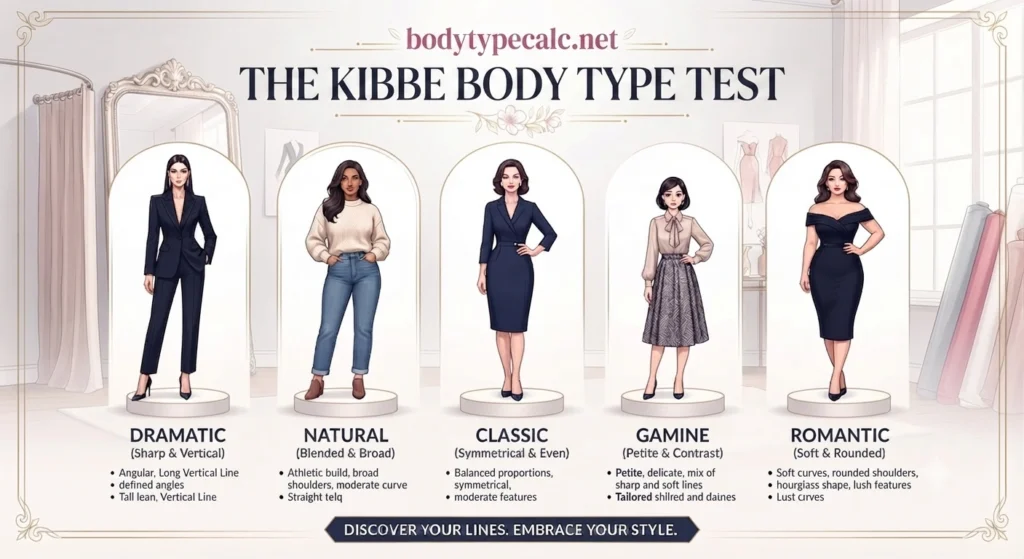
Your image identity is based on the combination of your natural features. The system places you into one of 13 Kibbe body types, grouped into five families: Dramatic, Natural, Classic, Gamine, and Romantic.
How to Take the Kibbe Body Type Test
The test takes a little longer than a standard body shape quiz because it evaluates more than just body proportions. Follow these steps to get the most accurate result.
Answer each question honestly
Choose the answers that best match your natural body and facial features. Avoid selecting the option you wish you had, as this can affect your result.
Look at your natural features
Focus on your natural bone structure, body proportions, and facial features instead of your clothing, hairstyle, or posture.
Avoid comparing yourself with celebrities
Reference images can help you understand each Kibbe type, but base your answers on your own features instead of comparing yourself with celebrities or influencers.
View your estimated Kibbe type
After answering every question, review your results to see which Kibbe body type best matches your natural features. The final result is based on the overall balance of your bone structure, body proportions, and facial features, rather than a single measurement.
What Does the Test Evaluate?
The Kibbe Body Type Test evaluates several natural features to determine your Kibbe Image Identity. Each section focuses on a different part of your overall appearance.
Bone Structure
This section evaluates your vertical line, shoulder shape, and the proportions of your arms, legs, hands, and feet. Bone structure is one of the most important factors because it stays largely the same, even when your weight changes.
Height & Vertical Line
Vertical line isn’t simply your height. It describes how tall or compact you appear based on your body proportions, including your torso, limbs, and shoulder width.
Body Flesh
This section evaluates how soft or defined your body appears by looking at your bust, waist, hips, arms, and thighs. It focuses on your natural body lines instead of your current weight.
Facial Features
Your jawline, nose, cheekbones, eyes, and lips are also evaluated. Together, these features help determine whether your appearance leans more toward soft (yin) or sharp (yang) characteristics.
Overall Balance (Yin & Yang)
The final result combines all of these features to determine your overall Yin and Yang balance. Most people have a blend of both, and that balance determines their Kibbe Image Identity.
Understanding Yin and Yang in the Kibbe System
Yin and Yang are the foundation of the Kibbe Body Type system. Understanding these concepts makes it easier to interpret your Kibbe test results.
What is Yin?
Yin represents soft, rounded, and delicate features. It may appear through curved bone structure, softer body lines, or rounded facial features.
What is Yang?
Yang represents sharp, angular, and structured features. It often appears in straight body lines, defined bone structure, and prominent facial features.
Why both matter
Most people have a combination of Yin and Yang characteristics rather than falling entirely into one category. Your unique balance of these traits determines your Kibbe Image Identity.
How balance creates different Kibbe types
Different combinations of Yin and Yang create the 13 Kibbe body types. For example, someone with strong Yang bone structure and softer Yin facial features may have a different image identity than someone whose features are consistently Yang.
Kibbe Body Types Explained
Each Kibbe body type is defined by a unique balance of Yin and Yang across your bone structure, body proportions, and facial features. Here’s a quick overview of all 13 Kibbe Image Identities.
Dramatic
Soft Dramatic
Flamboyant Natural
Natural
Soft Natural
Dramatic Classic
Classic
Soft Classic
Flamboyant Gamine
Gamine
Soft Gamine
Theatrical Romantic
Romantic
How Does the Test Determine Your Kibbe Type?
Your Kibbe Image Identity isn’t based on a single measurement or feature. Instead, the test evaluates several characteristics together to identify the balance of Yin and Yang that best matches your natural appearance.
Bone structure
Your bone structure forms the foundation of your Kibbe Image Identity. The test looks at your shoulder shape, limb length, hand and foot size, and overall frame because these features remain mostly unchanged regardless of weight.
Body proportions
Your bust, waist, hips, and overall body lines help refine the result. Rather than focusing on a single measurement, the test evaluates how your proportions work together.
Vertical line
Vertical line isn’t simply your height. It describes how tall, moderate, or compact you appear based on your overall proportions, which plays a key role in separating types like Dramatic, Classic, and Gamine.
Yin/Yang balance
The most important step is evaluating your overall balance of soft (Yin) and sharp (Yang) features. Most people have a mix of both, and that unique balance determines which of the 13 Kibbe body types fits best.
Overall image
The final result combines your bone structure, body proportions, facial features, and Yin–Yang balance into a complete Image Identity. Instead of focusing on individual features, the Kibbe system looks at your overall visual impression to recommend styles that naturally complement your body.
Kibbe Test vs Body Shape Calculator
Although both tools help you understand your body, they serve different purposes. A Body Shape Calculator uses measurements to identify your silhouette, while the Kibbe Body Type Test evaluates your natural body lines and overall Image Identity.
| Kibbe Body Type Test | Body Shape Calculator |
| Evaluates bone structure, body proportions, and facial features | Uses bust, waist, and hip measurements |
| Identifies 13 Kibbe Image Identities | Identifies around 7 body shapes |
| Focuses on Yin and Yang balance | Focuses on body proportions |
| Best for personal styling | Best for understanding body shape |
| Takes longer to complete | Gives results in seconds |
Which one should you use?
If your goal is to understand your body shape for clothing fit, a Body Shape Calculator is the better choice. If you want styling advice based on your natural body lines, facial features, and overall appearance, the Kibbe Body Type Test provides a more detailed analysis.
Many people use both tools together. Your body shape explains your proportions, while your Kibbe Image Identity helps you choose clothing styles, fabrics, and silhouettes that complement your natural features. See how the two systems differ in our Body Shape vs Kibbe guide.
Kibbe Test vs Body Type Calculator
Both tools help you understand your body, but they focus on different aspects and serve different purposes.
Difference
A Body Type Calculator classifies your overall build into categories such as ectomorph, mesomorph, or endomorph. The Kibbe Body Type Test focuses on your bone structure, body proportions, and Yin–Yang balance to identify your Image Identity.
When to use each
Use a Body Type Calculator to understand your overall physique and frame. Choose the Kibbe Body Type Test when you want clothing recommendations based on your natural body lines and overall proportions.
Kibbe Test vs Body Shape Quiz
Both tools can help you choose flattering clothing, but they measure different features and provide different levels of detail.
Difference
A standard Body Shape Quiz focuses mainly on your waist, bust, hips, and overall proportions. The Kibbe Body Type Test goes further by evaluating your bone structure, body proportions, facial features, and Yin–Yang balance through a more detailed assessment.
Which one is easier?
A regular body shape quiz is faster and simpler, usually taking under a minute to complete.
Which one is more detailed
The Kibbe Body Type Test is much more detailed, identifying one of 13 Kibbe Image Identities instead of just a few broad body shape categories.
Why Knowing Your Kibbe Type Matters
Knowing your Kibbe Image Identity makes choosing clothes much easier. Instead of following every trend, you can choose styles that naturally complement your body lines and proportions.
Better clothing choices
Your Kibbe type helps you choose clothing lines, silhouettes, and fabrics that complement your natural body instead of working against it.
Develop a Personal Style
Instead of following every fashion trend, you can build a wardrobe that feels consistent and complements your natural features.
Shop with More Confidence
Once you understand your Image Identity, it becomes easier to recognize flattering pieces before trying them on, making shopping faster and more confident.
Build a Smarter Wardrobe
Choosing clothes that suit your Kibbe type often leads to fewer unworn items and a wardrobe where more pieces naturally work together.
Understanding your natural lines
The Kibbe system encourages you to focus on your body’s natural lines and proportions instead of clothing size alone, helping you build a more balanced personal style.
Can Your Kibbe Type Change?
Your Kibbe Image Identity is based primarily on your bone structure, which remains largely the same throughout adulthood. While some physical changes can affect your appearance, they usually don’t change your core Kibbe type.
Weight changes
Losing or gaining weight can change your body proportions and soften or define certain features, but it doesn’t change your underlying bone structure.
Age
As you age, your facial features and body contours may gradually change. These changes can slightly affect your overall appearance, especially if your features fall between two Kibbe types.
Pregnancy
Pregnancy temporarily changes your body proportions and body lines, so it’s usually best to reassess your Kibbe type after your body has naturally recovered.
Muscle gain
Building muscle can make your body appear more defined, but it doesn’t change your frame, shoulder shape, or vertical line, which are key parts of the Kibbe system.
Why Bone Structure Matters Most
Bone structure is the foundation of the Kibbe Body Type Test. Since your frame changes very little over time, most people keep the same Kibbe Image Identity throughout adulthood.
Common Mistakes When Taking a Kibbe Test
Small mistakes can easily affect your result. Avoid these common errors to get a more accurate Kibbe Image Identity.
Tips for Better Results
A few simple habits can make your results much more reliable.
Frequently Asked Questions
Conclusion
The Kibbe Body Type Test provides a more detailed style framework than a simple body shape result. Instead of focusing only on measurements, it evaluates your bone structure, body proportions, and natural lines to identify your Kibbe Image Identity.
Use your result as a style guide rather than a strict label. If your result falls between two types, revisit the test after taking another look at your natural features.
For a more complete understanding of your body, pair the Kibbe Body Type Test with a Body Type Calculator, Body Measurement Calculator, or Figure Calculator. Together, these tools give you a clearer understanding of your body proportions and help you make more confident styling decisions.