
Spoon Body Shape: Find Your Measurements and Dress for Your Proportions
The spoon shape is often confused with the pear shape because both have fuller hips than the upper body. The main difference is how pronounced the lower curve is, often with a visible shelf just below the waist that isn’t usually seen in a classic pear shape.
Here’s what the shape actually is, how to check your own numbers, and what genuinely helps once you’re standing in a fitting room wondering why jeans that fit your hips gap everywhere else.
Spoon Body Shape
Your hips are more prominent than your shoulders and bust, creating a fuller lower-body silhouette. A defined waist and rounded hips are common characteristics of the spoon body shape.
Also known as: Spoon shape, spoon figure.
Similar body shapes: Pear, Triangle.
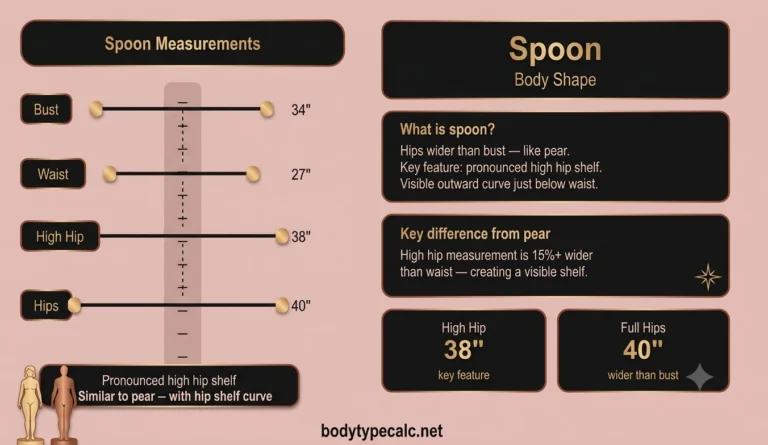
What Is a Spoon Body Shape?
A spoon body shape has hips noticeably wider than the bust or shoulders, a well-defined waist, and fuller hips and upper thighs. Many women with this shape also have a slight shelf-like curve just below the waist, one of its most recognizable features.
The spoon is often described as a more pronounced version of the pear, but not everyone with wider hips is a spoon. The difference comes down to how much wider the hips are than the bust and whether that shelf-like curve is present. Typical spoon measurements include the following:
These are general guidelines. Many women naturally fall somewhere between a pear and a spoon shape rather than fitting neatly into one category.
At a glance
| Measurement | Typical range |
| Hips vs bust | At least 6 inches wider |
| Waist | Well defined |
| Lower body | Fuller hips and thighs |
| Waist-to-hip ratio | Around 0.70–0.80 |
The High Hip Measurement That Separates Spoon From Pear
If you only measure bust, waist, and hips, the spoon and the pear can look almost identical on paper. The measurement that actually tells them apart is the high hip, taken about three to four inches below your natural waist, over the top of the hip bones.
In a spoon shape, the high hip reads noticeably wider than the waist, wider than you’d expect just from looking at the hip-to-bust gap alone. That’s the shelf people mean when they describe a spoon as having “more curve” than a standard pear. If your high hip is only a little wider than your waist, you’re more likely looking at a plain pear result instead, even with wide hips.
Types of Spoon Body Shape
Not every spoon looks the same. Most fall into one of three variations.
Classic spoon
A classic spoon has hips noticeably wider than the bust, a clearly defined waist, and a fairly balanced upper body overall.
Soft spoon
A soft spoon is gentler, with rounded hips and softer curves rather than a sharply dramatic hip-to-bust gap.
Curvy spoon
A curvy spoon has more pronounced hip curves and fuller thighs while still maintaining a clearly defined waist.
Check Your Spoon Body Shape Proportions
Enter your bust, waist, high hip, and hip measurements to see whether your proportions match a spoon body shape.
How to Measure for a Spoon Body Shape
Bust
The fullest part, tape kept level all the way around.
Waist
The narrowest point, after a normal exhale.
Hips
The fullest part of your hips and seat, feet together.
High hip
About three to four inches below your waist, over the hip bones. This is the measurement that actually confirms spoon over pear, so don’t skip it if you can help it.
If your hips are much wider than your bust, your waist is clearly defined, and your high hip measures noticeably wider than your waist, you likely have a spoon body shape.
Spoon Compared to Other Shapes
Comparing a spoon shape with other body types makes it easier to understand your natural proportions and identify your figure more accurately.
Spoon vs rectangle
Spoon has a defined waist with noticeably fuller hips. A rectangle keeps bust, waist, and hips fairly even across the board.
Why Jeans Can Be Difficult to Fit
Many women with a spoon body shape find that jeans fit the hips but feel loose at the waist.
High-rise jeans and styles with a little stretch usually provide a more comfortable, better-fitting option. If needed, a simple waist alteration can make jeans much more comfortable.
What to Wear for a Spoon Body Shape
The goal is balancing the upper and lower body while letting your naturally defined waist stay visible. Use our Dress Size Calculator to find the clothing size that best matches your measurements.
Tops
Boat neck and square neck tops both add width up top to meet the hips halfway. Wrap tops build in a waist cue through the fabric itself. Structured blouses hold their shape well against a fuller lower body without competing with it.
Dresses
Wrap dresses handle the whole silhouette in one piece. A-line and fit-and-flare dresses both let the skirt do the balancing work below a defined waist. For more detailed styling ideas, explore our Spoon Body Shape Outfits guide.
Bottoms and jeans
Straight-leg and bootcut jeans give a clean line without clinging to the fullest part of the hip. Wide-leg trousers and A-line skirts do something similar, skimming rather than hugging.
Outerwear
Tailored blazers and structured jackets add shape up top. Belted coats keep the waist visible even under a heavier layer.
By occasion
For work, a structured blouse with straight-leg trousers keeps things polished. For something casual, a wrap top with bootcut jeans is easy and everyday. For formal occasions, an A-line or wrap dress with a defined waist flatters this shape especially well.
Waist-to-Hip Ratio and Health
The waist-to-hip ratio (WHR) is calculated by dividing your waist measurement by your hip measurement. Many women with a spoon shape have a waist-to-hip ratio between 0.70 and 0.80 because their hips are noticeably wider than their waist.
WHR is helpful for understanding your body proportions, but it doesn’t determine your body shape by itself. Your bust, waist, and hip measurements all work together to identify your natural body shape.
Can a Spoon Body Shape Change?
Yes. Your body shape can change over time due to:
Although your bone structure remains the same, changes in muscle and body fat can slightly affect your overall proportions.
Frequently Asked Questions
Conclusion
A spoon body shape is defined by a well-defined waist and fuller hips, creating naturally curvy proportions. Understanding your measurements, especially your high hip, makes it easier to choose clothing that fits properly instead of guessing whether you’re a spoon or pear shape.
Rather than trying to hide your curves, focus on creating balance, highlighting your waist, and wearing styles that actually work with the shape you have.