
How to Measure Your Bust: Complete Guide for Women & Men
Getting an accurate bust measurement is essential for finding the right clothing size, bra fit, and body shape. This guide explains exactly where to measure your full bust, upper bust, and underbust, how to measure each one step by step, and the common mistakes that can affect your results.
Use Your Bust Measurement
Enter your bust, waist, high hip, and hip measurements into our free Body Shape Calculator to discover your body shape in seconds.
Free and easy to use
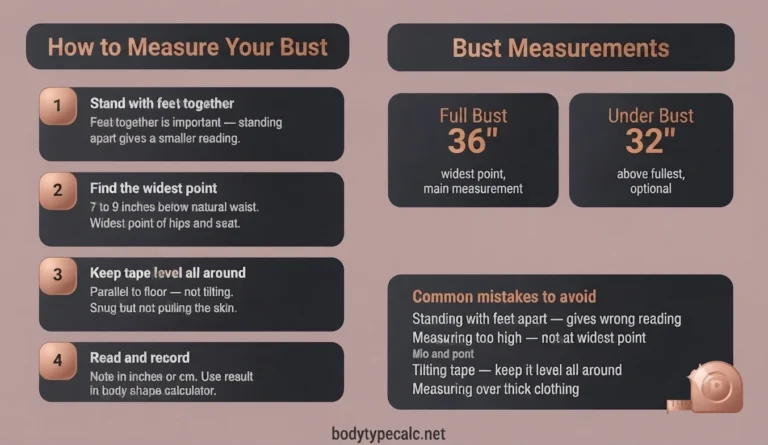
Full Bust, Upper Bust, and Underbust: What Is the Difference?
Bust measurements aren’t all taken at the same place. Depending on what you’re measuring for, you may need your full bust, upper bust, or underbust. Here’s what each one means.
Full Bust
The full bust is measured around the fullest part of your chest, usually across the nipple line. This is the standard measurement used for body shape calculators, dress sizing, tops, and most clothing size charts. When a size guide asks for your bust measurement, this is usually the one it means.
Upper Bust
The upper bust is measured above the fullest part of your chest, just below the armpits. This measurement is commonly used for shirt sizing, tailored jackets, swimsuits, and some bra fitting methods. In men’s clothing, this area is generally referred to as the chest measurement.
Underbust
The underbust is measured directly beneath the chest, where the band of a bra sits. It’s mainly used to determine bra band size and is an essential measurement when choosing a well-fitting bra.
How to Measure Your Full Bust (Step-by-Step)
Measuring your full bust only takes a minute when you follow the correct method. Use these steps to get an accurate and consistent measurement.
Step 1: Wear the right clothing
For women, measure while wearing a well-fitting, non-padded bra or over a thin fitted top. Avoid padded or push-up bras because they can increase your bust measurement. Men should measure over a thin T-shirt or directly against the skin.
Step 2: Find the fullest point
Stand upright with your arms relaxed at your sides. Locate the fullest part of your chest, which is usually across the nipple line.
Step 3: Wrap the tape around
Wrap a flexible measuring tape around the fullest part of your bust. Make sure the tape stays level and parallel to the floor from front to back without twisting.
Step 4: Keep the tape snug, not tight
The tape should rest comfortably against your body without squeezing your chest. It should be snug but not tight, with enough room to slide one finger underneath.
Step 5: Breathe normally and read
Keep a relaxed posture and breathe normally. Read the measurement where the tape meets the zero end. Avoid holding your breath or expanding your chest while measuring.
Step 6: Measure twice
Take the measurement twice to check for accuracy. If the readings differ by more than ½ inch (1 cm), measure a third time and use the most consistent result. Measuring under similar conditions each time also helps you track changes more reliably.
How to Measure Underbust (Band Measurement)
Your underbust measurement is taken directly beneath your chest and is mainly used to determine your bra band size. Unlike a full bust measurement, the tape sits lower and is held a little firmer against the body.
Step 1: Wear a Non-Padded Bra or Thin Top
For the most accurate result, wear a well-fitting, non-padded bra or measure over bare skin. Avoid bulky clothing that can add extra thickness.
Step 2: Position the Tape
Wrap the measuring tape directly beneath your bust, where the bra band naturally sits. Make sure the tape goes straight around your body.
Step 3: Keep the Tape Level and Firm
Keep the tape parallel to the floor and snug against your body without digging into the skin. Unlike a bust measurement, the underbust tape should fit firmly because it measures your band size.
Step 4: Breathe Normally
Relax your shoulders, breathe out naturally, and avoid lifting your chest while taking the measurement.
Step 5: Read and Record the Measurement
Read the number where the tape meets the zero end. Measure a second time to confirm accuracy and record the result in inches or centimeters.
How Underbust Is Used for Bra Size
Your underbust measurement forms the basis of your bra band size. Many modern bra brands use your actual underbust measurement directly, while some older sizing systems apply different band calculations. Because sizing methods vary between brands, it’s always a good idea to compare your measurement with the manufacturer’s bra size chart before buying.
What Your Bust Measurement Is Used For
The exact bust measurement you need can shift slightly depending on what you’re using it for. Here’s how it breaks down by purpose.
Bust Measurement for Body Shape
Use your full bust measurement together with your waist and hip measurements. The relationship between your bust and hips helps determine whether your body shape is hourglass, pear, apple, rectangle, inverted triangle, or another shape.
Bust Measurement for Dress Size
Most dresses are sized using your full bust measurement. Compare your measurement with the brand’s size chart, as sizing can vary between manufacturers. If you’re between sizes, choosing the larger size usually provides a better fit.
Bust Measurement for Bra Size
Bra sizing uses both your full bust and underbust measurements. The underbust determines your band size, while the difference between your full bust and underbust helps estimate your cup size. Since bra sizing isn’t identical across brands, always check the manufacturer’s size guide.
Bust Measurement for Shirts and Tops
Some clothing brands use your full bust, while others use your upper bust or chest measurement, especially for tailored shirts and jackets. Men’s shirts are generally sized using the chest measurement, while women’s sizing varies by brand.
Bust Measurement for Swimsuits
Swimwear sizing usually combines your full bust, waist, and hip measurements. One-piece swimsuits rely on all three measurements, while bikini tops may follow their own separate size charts.
Bust Measurement for Sewing and Patterns
Sewing patterns often require both your full bust and upper bust measurements. Comparing the two helps determine whether a full bust adjustment (FBA) is needed for a better-fitting garment, especially around the chest.
How to Measure Bust Without a Measuring Tape
If you don’t have a flexible measuring tape, you can still estimate your bust measurement using a few simple alternatives.
String or ribbon method
Wrap a non-stretchy string, ribbon, or cord around the fullest part of your bust. Mark the point where the ends meet, then lay it flat and measure the length with a ruler. This gives a close estimate of your bust circumference.
Using a Well-Fitting Top
Lay a well-fitting shirt or top flat on a smooth surface. Measure straight across the fullest part of the chest from one side to the other, then double the measurement to estimate the garment’s bust circumference. While this method is useful for general clothing sizes, it’s not accurate enough for bra sizing, where precise body measurements are recommended.
How to Measure Bust for Men and Women
The measuring method is almost the same for everyone, but the way the measurement is used differs slightly for men and women.
How to measure bust for women
Wear a well-fitting, non-padded bra or measure over bare skin. Wrap the measuring tape around the fullest part of your bust, usually across the nipple line, keeping the tape level all the way around. This full bust measurement is commonly used for body shape analysis, dress sizing, tops, and other clothing. For bra sizing, you’ll also need a separate underbust measurement.
How to measure bust for men
Wrap the measuring tape around the fullest part of your chest, usually across the nipple line, while standing naturally with your arms relaxed. Keep the tape level and snug without pulling it tight. In men’s clothing, this measurement is typically called the chest measurement and is commonly used for shirts, jackets, suits, and other fitted garments.
Bust Measurement Mistakes to Avoid
Small measuring mistakes can easily change your bust measurement and affect clothing sizes or bra fit. Here are the most common ones to avoid.
Measuring in a padded bra
Padded and push-up bras add extra volume, making your bust measurement larger than it really is. For the most accurate result, wear a well-fitting, non-padded bra or measure over bare skin.
Keeping the Tape Uneven
The measuring tape should stay level and parallel to the floor all the way around your body. If it drops at the back or rises at the front, your measurement won’t be accurate.
Measuring at the wrong Spot
Always measure around the fullest part of your bust. Measuring too high records your upper bust, while measuring too low captures your underbust instead.
Pulling the Tape Too Tight
The tape should rest comfortably against your body without compressing your chest. A tape that’s too tight gives a smaller measurement than your actual bust size.
Measuring Over Thick Clothing
Bulky sweaters, hoodies, or heavy layers add extra thickness and can increase your measurement. Measure over thin, fitted clothing or directly on your skin for the most reliable result.
Using Your Full Bust for Bra Band Size
Your bra band size is based on your underbust measurement, not your full bust. Mixing these two measurements is one of the most common reasons for choosing the wrong bra size.
Frequently Asked Questions
Conclusion
An accurate bust measurement takes less than a minute, but it has a big impact on body shape results, bra sizing, clothing fit, and overall sizing accuracy. Measure at the correct point, keep the tape level and comfortably snug, and use the same method each time for consistent results.
Once you have your measurement, use it with a Body Shape Calculator, Dress Size Calculator, Body Measurement Calculator, or combine it with your waist and hip measurements to get a complete picture of your body proportions.