How to Measure Your Hips: Complete Guide for Men & Women
Getting your hip measurement right is just as important as measuring your waist. It’s used for everything from body shape calculations and clothing sizes to waist-to-hip ratio and other body measurements. This guide shows you exactly where to measure your hips, how to measure them correctly step by step, common mistakes to avoid, and tips to get the most accurate result every time.
Hip Measurement
Enter your bust, waist, high hip, and hip measurements into our free Body Shape Calculator to instantly discover your body shape and understand your proportions.
Supports inches and centimeters.
Where to Measure Hips
Finding the correct measuring point is the most important part of getting an accurate hip measurement. Your lower body has three different measuring points, and each one serves a different purpose.
Natural Waist
The natural waist is the narrowest part of your torso, usually 1 to 2 inches above your belly button. It serves as the starting reference for other lower body measurements and is commonly used for body shape calculations, dress sizing, and waist-to-hip ratio.
High Hip
The high hip is measured 3 to 4 inches below the natural waist, above the fullest part of your hips. It captures your upper hip curve and is often used in detailed body shape calculators to distinguish body shapes such as pear and spoon.
Full Hips
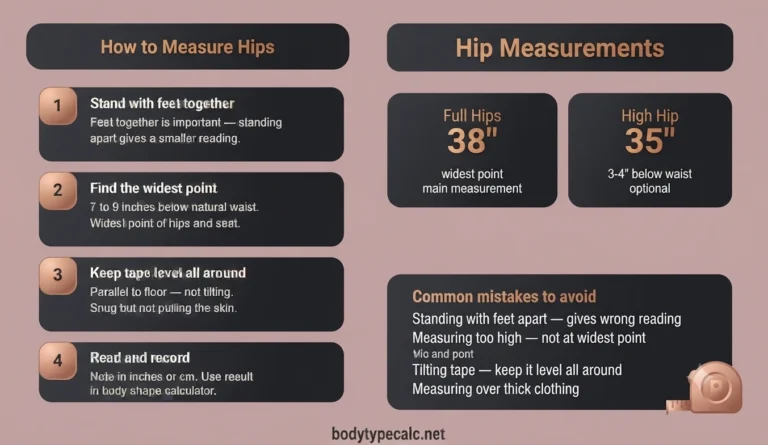
The full hip measurement is taken around the widest part of your hips and buttocks, usually 7 to 9 inches below the natural waist. This is the standard hip measurement used for body shape calculators, waist-to-hip ratio, clothing sizes, dress measurements, and pants sizing.
How to Measure Full Hips (Step-by-Step)
Once you’ve found the correct measuring point, measuring your hips only takes a minute. Follow these steps for the most accurate result.
Step 1: Stand correctly
Stand upright with your feet together and your arms resting naturally at your sides. Keeping your feet apart can change your hip width and lead to an inaccurate measurement.
Step 2: Find the widest point
Starting at your natural waist, move the tape downward while checking in a mirror until you reach the widest part of your hips and buttocks. For most people, this is about 7 to 9 inches below the natural waist.
Step 3: Wrap the tape around
Wrap the measuring tape around the fullest part of your hips, making sure it stays straight and parallel to the floor all the way around, including across your back.
Step 4: Keep the tape snug
The tape should rest comfortably against your body without digging into your skin. It should feel snug, but you should still be able to slide one finger underneath it.
Step 5: Breathe normally and read
Stand naturally, breathe normally, and read the number where the tape meets the starting end. Avoid holding your breath, sucking in your stomach, or tightening your muscles.
Step 6: Measure twice
Repeat the measurement once more to confirm the result. If the two readings differ by more than ½ inch (1 cm), take a third measurement and use the middle value.
How to Measure High Hip
A high hip measurement isn’t required for most clothing sizes, but it can improve the accuracy of detailed body shape calculations. Here’s how to measure it correctly.
Where to measure high hip
Start by locating your natural waist, then measure 3 to 4 inches below it. Wrap the measuring tape around your body at this point, keeping it level and parallel to the floor. This is your high hip measurement.
When is a high hip measurement needed?
A high hip measurement is mainly used in advanced body shape calculators. It helps distinguish similar body shapes, such as pear and spoon, by measuring the curve above the fullest part of the hips. For most clothing sizes, the full hip measurement is usually all that’s needed.
What Your Hip Measurement Is Used For?
Your hip measurement is used for more than just clothing sizes. Depending on what you’re measuring, it can help determine your body shape, clothing fit, body proportions, and even body fat percentage.
Hip Measurement for Body Shape
Use your full hip measurement together with your bust, waist, and high hip measurements. Comparing these proportions helps identify body shapes such as hourglass, pear, rectangle, apple, and spoon.
Hip Measurement for Pants and Jeans
Measure around the fullest part of your hips and compare the result with the brand’s size chart. If your waist and hips fall into different sizes, choose the size that fits your hips best, as it’s usually easier to adjust the waist.
Hip Measurement for Dress and Skirt Size
Most dress and skirt size charts use your bust, waist, and full hip measurements. For fitted dresses, pencil skirts, and bodycon styles, your hip measurement is often the most important measurement for a comfortable fit.
Hip Measurement for Waist-to-Hip Ratio
Your waist-to-hip ratio (WHR) is calculated by dividing your waist measurement by your full hip measurement, using the same unit for both. This ratio is commonly used to assess body fat distribution and compare overall body proportions.
Hip Measurement for Body Fat
The U.S. Navy Body Fat Formula uses the full hip measurement for women, along with the waist and neck measurements, to estimate body fat percentage. Men do not use hip measurement in this formula.
Hip Measurement for Underwear and Swimwear
Many underwear, bikini, and swimwear brands size their products using your full hip circumference. Since sizing varies between brands, always compare your measurement with the brand’s size chart before buying.
How to Measure Hips Without a Tape Measure
If you don’t have a flexible measuring tape, you can still estimate your hip measurement using one of these simple methods.
String or Ribbon Method
Wrap a non-stretchy string or ribbon around the fullest part of your hips while standing with your feet together. Mark the point where the ends meet, then lay the string flat and measure it with a ruler.
Using a Pair of Pants or Jeans
Lay a pair of well-fitting pants or jeans flat on a smooth surface. Measure straight across the widest part of the hip area and double that number to estimate the garment’s hip circumference. Since clothing includes extra room for comfort, your actual body measurement is usually 1 to 2 inches larger.
How to Measure Hips for Men and Women
The measuring process is almost the same for everyone, but the way the measurement is used can vary slightly.
How to measure hips for women
Measure around the fullest part of your hips and buttocks, usually 7 to 9 inches below the natural waist, while standing with your feet together. For more accurate body shape calculations, it’s also helpful to measure your high hip.
How to measure hips for men
Measure around the widest part of your hips and seat using the same method. For men, the hip measurement is commonly used for body shape analysis, clothing sizes, and ensuring a comfortable fit in pants and trousers.
How to Measure Hips with Hip Dips
Hip dips, sometimes called violin hips, are natural inward curves between the hip bone and the upper thigh. They don’t change the way you measure your hips, but they can make it harder to find the correct measuring point.
Where to Measure If You Have Hip Dips
Wrap the measuring tape around the widest part of your hips and buttocks, not around the hip dip itself. Depending on your body, the widest point may be above the dip at the hip bone or below it across the buttocks and upper thighs. Measure wherever your body has the largest circumference.
Do Hip Dips Affect Your Body Shape?
No. Hip dips are a natural part of your bone structure and don’t determine your body shape. Your body shape is based on the overall relationship between your bust, waist, and hip measurements, so people with hip dips can have hourglass, pear, rectangle, apple, spoon, or any other body shape.
Hip Measurement Mistakes to Avoid
Even small measuring mistakes can change your hip measurement and affect clothing sizes or body shape results. Here are the most common ones to avoid.
Standing with Your Feet Apart
Always stand with your feet together. Standing with your feet apart changes your body position and can make your hip measurement smaller than it really is.
Keeping the Tape Uneven
The measuring tape should stay level and parallel to the floor all the way around your hips. If it slips lower at the back or higher at the front, the reading won’t be accurate.
Measuring at the Wrong Spot
Measure around the widest part of your hips and buttocks. Measuring too high records your high hip, while measuring too low misses the fullest part of your hips.
Mixing Up High Hip and Full Hip
High hip and full hip are different measurements taken at different locations. If a calculator asks for both, measure each one separately instead of using the same number twice.
Using pants size as body measurement
Your clothing size isn’t the same as your actual hip measurement. Always measure your body directly rather than using the size printed on your jeans or trousers.
Pulling the tape too tight
The tape should fit snugly without pressing into your skin. Pulling it too tightly can reduce your measurement and give an inaccurate result.
Tips for an Accurate Hip Measurement
A few simple habits can make your hip measurement more consistent and reliable. Follow these tips for the best results.
Measure to the Nearest ¼ Inch or 0.5 cm
Record your measurement as accurately as possible instead of rounding to the nearest whole inch or centimeter. Small differences can affect body shape calculations and clothing sizes.
Keep your feet together
Stand with your feet together and your weight evenly balanced. This helps maintain your natural hip shape and gives a more consistent measurement.
Measure twice
Take your hip measurement at least twice. If the readings don’t match, measure again and use the average or the closest two results.
Use the Same Unit Every Time
Choose either inches or centimeters and stick with that unit whenever you measure. Using the same unit makes it easier to compare results over time and follow clothing size charts accurately.
Related Measurements
Your hip measurement is closely connected to several other body measurements, but each one is taken at a different location and serves a different purpose.
Hips vs Waist
Your waist measurement is taken at the narrowest part of your torso, while your hip measurement is taken around the fullest part of your hips and buttocks. These two measurements are commonly used together for body shape analysis, waist-to-hip ratio, and clothing sizing.
Hips vs High Hip
The high hip is measured 3 to 4 inches below the natural waist, above the fullest part of your hips. The full hip measurement is taken lower, at the widest point of your hips and seat. Some advanced body shape calculators use both measurements for more accurate results.
Hips vs Thigh Measurement
A hip measurement goes around your entire lower body at its widest point, while a thigh measurement is taken around one thigh, usually just below the hip crease. Hip measurements are mainly used for body shape and clothing sizes, whereas thigh measurements are more useful for fitted pants, activewear, and custom tailoring.
Frequently Asked Questions
Conclusion
A correct hip measurement takes only a minute, but it plays an important role in body shape analysis, waist-to-hip ratio, clothing sizes, and other body measurements. Measure around the fullest part of your hips, keep the tape level and snug, and use the same measuring method each time for consistent results.