How to Measure Your Waist at Home (Easy Guide)
Getting your waist measurement right is more important than most people realize. It’s used for everything from body shape calculators and clothing sizes to health assessments. This guide explains where to measure your waist, how to measure it correctly step by step, common mistakes to avoid, and how to get the most accurate result.
Waist Measurement
Measure around the natural waist, the narrowest part of your torso, usually 1–2 inches above the belly button. An accurate waist measurement is essential for body shape, clothing sizes, and body composition calculations.
Common Uses: Body Shape, WHR, Body Fat, Dress Size, Pants Size, Jeans, and Belt Size.
What Is a Waist Measurement?
Before measuring, it helps to understand what your waist measurement represents and why it matters. Here’s what you need to know.
Waist measurement definition
A waist measurement is the circumference of your torso at its narrowest point, measured with a flexible tape measure in either inches or centimeters.
Why waist measurement matters
Your waist measurement is used for much more than clothing sizes. It helps calculate body proportions, supports health assessments, and improves the accuracy of several body composition tools.
What your waist measurement is used for
Where Is Your Natural Waist?
Finding the correct spot is the most important part of measuring your waist. Measuring too high or too low can affect clothing sizes, body shape results, and health calculations.
What is the natural waist?
Your natural waist is the narrowest part of your torso, located between your ribcage and hip bones.
How to find your natural waist
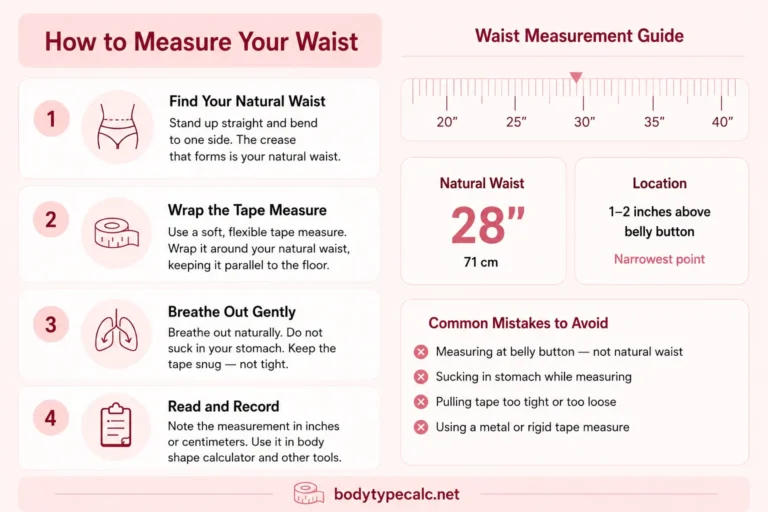
Stand up straight and bend slightly to one side. The crease that forms along your side marks your natural waist. For most people, it’s about one to two inches above the belly button.
Natural waist vs belly button
Your belly button isn’t always located at your natural waist. In most cases, the natural waist sits slightly above it, so measuring directly across the belly button may produce a less accurate result.
Natural Waist vs Pants Waist
Most pants sit lower on the body, closer to the hips, rather than at your natural waist. For body shape calculators, health assessments, and accurate body measurements, always measure at your natural waist instead of your pants waistband.
What You Need Before Measuring
A little preparation helps you get a more accurate waist measurement. Before you start, make sure you have the following.
Flexible measuring tape
Use a soft, flexible measuring tape, like the kind used for sewing. It wraps comfortably around your waist and provides much more accurate measurements than a rigid metal tape.
Wear light clothing
For the most accurate result, measure over bare skin, underwear, or thin fitted clothing. Avoid bulky layers that can add extra inches.
Stand naturally
Stand upright in a relaxed posture with your feet shoulder-width apart. Don’t suck in your stomach or adjust your posture while measuring.
Measure at the same time each day (optional)
Your waist measurement can vary slightly throughout the day due to meals, hydration, and bloating. If you’re tracking progress, measuring at the same time each day helps keep your results more consistent.
How to Measure Your Waist (Step-by-Step)
Measuring your waist correctly only takes a minute. Follow these steps for the most accurate result.
How to Measure Your Waist Without a Tape Measure
Don’t have a measuring tape? You can still get a fairly accurate waist measurement using one of these simple alternatives.
Use a string or ribbon
Wrap a non-stretchy string or ribbon around your natural waist and mark where the ends meet. Lay it flat against a ruler or measuring stick to find your waist measurement.
Use a belt
If you wear a belt at your natural waist, fasten it at your usual hole and measure from the buckle to that hole. This provides a rough estimate of your waist size.
Use a Strip of Paper and a Ruler
Wrap a strip of paper around your natural waist, mark where it overlaps, then measure that length with a ruler to calculate your waist circumference.
How to Measure Waist for Women
The measuring process is the same for everyone, but these tips help women get the most accurate result.
Natural waist position
For most women, the natural waist is the narrowest part of the torso, usually one to two inches above the belly button.
Dress measurement tips
When measuring for dresses, skirts, or high-waisted clothing, always use your natural waist instead of where the garment sits. Most fitted styles are designed around this measurement.
Common mistakes
The most common mistakes are measuring too low near the hips, pulling the tape too tightly, or measuring over bulky clothing, all of which can lead to inaccurate clothing sizes.
How to Measure Waist for Men
The measuring process is the same for men, but the correct measuring point depends on what the measurement will be used for.
Natural waist
For body shape calculators and general body measurements, measure at the natural waist, the narrowest part of your torso.
Waist for pants sizing
For trousers or jeans, measure where the waistband normally sits. Depending on the style, this is often at or slightly below the natural waist.
Waist for body fat (Navy Method)
The U.S. Navy body fat formula uses a different measuring point. Men should measure at the level of the navel (belly button) instead of the natural waist.
Waist Measurement for Different Purposes
The correct measuring position can vary slightly depending on what you’re using the measurement for.
For Waist-to-Height Ratio
Measure your natural waist and compare it with your height. Both measurements should be in the same unit for an accurate result.
Waist Measurement Mistakes to Avoid
Even small measuring mistakes can affect your result. Avoid these common errors for a more accurate waist measurement.
Tips for an Accurate Waist Measurement
A few simple habits help you get consistent and reliable results every time.
Waist Measurement vs Pants Size
| Body Waist | Pants Waist |
| Your actual measured circumference | A clothing label number |
| Taken at the natural waist | Taken at wherever the pants sit |
| More accurate for calculations | Runs about 1 to 2 inches smaller than body waist |
Your actual waist measurement and your pants size are not the same. For example, pants labeled as 32 inches often fit someone with an actual waist of 33–34 inches. For body shape calculators, health assessments, and body measurements, always use your actual waist measurement instead of your clothing size.
Waist Measurement vs Waist Circumference
These terms are often used interchangeably, but there’s a small difference in how they’re commonly used.
Are they the same?
For most people, yes. Waist circumference is simply the medical term for the same measurement—the distance around your waist at its narrowest point.
Medical use vs clothing use
In healthcare, waist circumference usually refers to a standardized measuring point used for health screening. For clothing, the measuring position may vary slightly depending on the garment or brand.
Healthy Waist Size
Waist size is commonly used as a general indicator of abdominal fat and potential health risk, but it should never be considered on its own.
Men
A waist circumference of more than 40 inches (102 cm) is generally associated with a higher risk of obesity-related health conditions in men.
Women
A waist circumference of more than 35 inches (88 cm) is generally associated with a higher risk of obesity-related health conditions in women.
Why waist size matters for health
A larger waist measurement often indicates more abdominal fat, which is linked to a higher risk of conditions such as heart disease and type 2 diabetes. However, waist size is only one health indicator and should be considered alongside other measurements and lifestyle factors.
Related Measurements
Your waist measurement is often used alongside other body measurements. Here’s how they differ.
Waist vs Hip Measurement
The waist is measured at the narrowest part of your torso, while the hip measurement is taken around the fullest part of your hips and buttocks.
Waist vs High Hip
The high hip is measured a few inches below the natural waist and above the fullest part of the hips. It’s commonly used for more detailed clothing fitting and body shape calculations.
Waist vs Belly Measurement
A belly measurement is usually taken at the level of the belly button. Since this point is often lower than the natural waist, it isn’t the standard measurement used for most body shape calculators or clothing size charts.
Frequently Asked Questions
Conclusion
An hourglass body shape is defined by balanced proportions, not by your weight or clothing size. Understanding your measurements can make shopping easier and help you choose styles that naturally suit your figure.
If you’re unsure whether you have an hourglass shape, use our Body Type Calculator to compare your bust, waist, and hip measurements. For a more complete picture, you can also check your Body Measurement Calculator and Figure Calculator to better understand your body proportions.