
Pear Body Shape: Measurements, Style Tips & How to Dress Your Figure
The pear is one of the most common body shapes and one of the most misunderstood. Most people think it just means “big hips,” but it’s really about proportions, hips that lead, and a waist that still stays clearly defined in between.
Here’s what the shape actually is, how to check it against your own measurements, and what genuinely helps once you’re standing in front of a rack of jeans wondering why the waist never sits right.
Pear Body Shape
Your hips are wider than your shoulders and bust, creating a balanced lower-body silhouette. A naturally defined waist is a common characteristic of the pear body shape.
Also known as: Triangle body shape, pear figure
Similar body shapes: Spoon
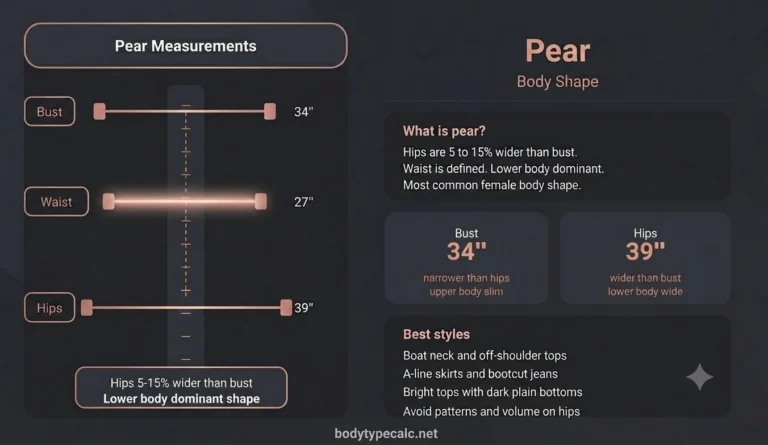
What Is a Pear Body Shape?
A pear body shape, sometimes called a triangle body shape, is defined by hips that are noticeably wider than the bust or shoulders, along with a naturally defined waist.
The defining feature isn’t simply having wider hips. It’s the relationship between all three measurements. A woman with measurements of 34-26-40 and another with 40-31-46 can both have a pear body shape because their proportions follow the same pattern even though the actual numbers are different.
Unlike an hourglass figure, where the bust and hips are balanced, a pear shape has hips that are naturally wider than the bust while the waist remains clearly defined.
Body shape isn’t determined by your clothing size, height, or weight. It’s based entirely on how your measurements relate to one another.
Pear Body Shape Measurements
Most women with a pear body shape share these general proportions:
If your hips are only 1 to 3.6 inches wider than your bust, you may fall between a soft hourglass and a soft pear. That’s completely normal. Body shapes exist on a spectrum, and plenty of people naturally fall close to the boundary between two categories rather than landing neatly in one.
The most accurate way to identify your body shape is by comparing bust, waist, and hip measurements together, rather than relying on appearance alone.
At a glance
| Measurement | Typical pear range |
| Hips vs bust | Hips at least 3.6 inches wider |
| Waist difference | At least 9 inches smaller than hips |
| Waist-to-hip ratio | Around 0.70–0.80 |
These are general guidelines, not strict rules. If your measurements are close to the boundary, it’s normal to share characteristics of more than one body shape.
Classic Pear, Soft Pear, and Spoon
Not every pear body shape looks exactly the same. Most fall into one of three variations, and they share the same underlying pattern at different intensities.
Classic Pear
A classic pear has hips clearly wider than the bust and a well-defined waist. Upper body stays balanced, hips and thighs carry more fullness, and the hip-to-bust difference is moderate rather than extreme. This is the shape most people picture when they think “pear.”
Soft Pear
A soft pear follows the same basic pattern, just more gently. Hips are slightly wider than the bust, the waist is a little less defined, and the overall silhouette appears softer and more balanced.
Spoon
A spoon shape is really a more pronounced pear. Hips sit much wider than the bust, the hip curve is more noticeable, and there’s sometimes a visible shelf just below the waist where the curve is especially rounded. Some style guides classify spoon as a separate shape, but its styling recommendations are very similar to those for a pear figure.
Check Your Pear Body Shape Proportions
Enter your bust, waist, and hip measurements to see whether your proportions match a pear body shape.
Why Your Measurements Matter
Knowing your body shape isn’t about changing your body. It’s about understanding how clothes are designed to fit different proportions.
Once you know your own numbers, shopping gets a lot easier. You’ll understand why certain jeans gap at the waist, why some tops feel more balanced than others, and which cuts naturally work with your shape instead of against it.
How to Measure for a Pear Body Shape
Accurate measurements are the key to identifying your body shape correctly. Even a small measuring mistake can shift the result, so keep the tape level and don’t pull it too tight.
Bust
Measure around the fullest part in a regular, non-padded bra. A heavily padded bra can increase this measurement and affect your results.
Waist
The narrowest point, usually just above the belly button, after a normal exhale.
Hips
The fullest part of your hips and seat, feet together so the tape stays level. Don’t measure your high hip here instead, since that will shrink the number and throw off the result.
If your measurements fall between two body shapes, that’s completely normal. Body shapes exist on a spectrum, and it’s common to share characteristics of more than one category.
Pear Body Shape vs Other Body Shapes
Understanding how the pear body shape compares to similar body shapes makes it easier to identify your natural proportions and choose the right styling approach.
Why Finding the Right Jeans Can Be Difficult
If you’ve ever found jeans that fit your hips but gap at the waist, you’re far from alone. Most jeans are cut with a smaller waist-to-hip difference than a lot of pear shapes naturally have, so the waistband simply isn’t built for the gap your body actually has.
The fix isn’t sizing down. That just squeezes the hips and thighs without actually closing the waist gap. What works better is buying for your hips first, since that’s the harder measurement to alter, and having the waist taken in afterward if it needs it. A simple waist alteration on jeans or trousers is usually inexpensive and solves the fit issue better than trying multiple sizes.
How to Dress a Pear Body Shape
The goal is to balance your proportions while keeping your waist visible. Finding the right clothing size also matters, so use our Dress Size Calculator to choose a size that matches your measurements.
Tops
Boat necks, square necklines, off-the-shoulder tops, wrap tops, puff sleeves, and anything with color or print all add a little visual interest up top, which balances a fuller lower half nicely. Very thin straps and overly plain, flat tops tend to do the opposite, making the top half look smaller by comparison.
Dresses
Wrap dresses, fit and flare, A-line dresses, and belted shirt dresses all work with this shape rather than against it. Dresses that add extra volume right at the hip, gathered skirts, hip pockets, and heavy pleating right at the widest point tend to add exactly where you don’t need more attention.
Jeans
High-waisted styles are the easiest starting point, with straight leg, bootcut, and wide leg all working well at a proper high rise. Dark washes usually create a more balanced look than lighter washes.
Bottoms
A-line skirts, midi skirts, wide-leg trousers, and straight-leg trousers all skim the hips rather than clinging to them, which tends to look more flattering than anything tight through that area.
Outerwear
Structured pieces help balance the proportions here; tailored blazers, wrap coats, and belted trench coats all add shape up top to meet the hips halfway.
By occasion
Work: A structured blazer with straight-leg trousers or an A-line skirt creates a polished, balanced look.
Casual: A boat-neck top with dark straight-leg jeans or wide-leg trousers makes an easy everyday outfit.
Formal: Wrap dresses, fit-and-flare gowns, and A-line dresses with a defined waist flatter your natural proportions. For more outfit ideas, see our Pear Body Shape Outfits guide.
Waist-to-Hip Ratio for Pear Shapes
Waist-to-hip ratio, or WHR, is calculated by dividing your waist measurement by your hip measurement. For most women with a pear body shape, WHR typically falls between 0.70 and 0.80.
WHR helps explain body proportions, but it cannot determine your body shape on its own. The real defining feature of a pear is that the hips are noticeably wider than the bust, not the ratio number by itself.
Is Pear the Most Common Body Shape?
Pear is one of the most common body shapes, although rectangle is slightly more common in most measurement studies. Body shape can also shift over time with weight changes, pregnancy, menopause, and exercise, so this isn’t a permanent label either way.
Frequently Asked Questions
Conclusion
A pear body shape is defined by fuller hips, a defined waist, and a narrower upper body. Understanding your measurements makes it much easier to choose clothes that fit well and create balanced proportions.
Focus on fitting your hips first, defining your waist, and adding visual balance to your upper body. The goal isn’t to hide your shape, but to dress in a way that complements your natural proportions.