
Ideal Weight Calculator | Calculate Ideal & Adjusted Body Weight
An Ideal Weight Calculator estimates your healthy weight range based on your height and gender using well-established medical formulas. If you’ve ever wondered, “How much should I weigh?” this calculator provides a practical reference point rather than an exact target weight. It’s a useful starting point, not a number you need to achieve exactly. This guide explains how the calculator works, the formulas it uses, how to interpret your results, and why ideal weight is only one part of overall health.
Ideal Weight Calculator
Enter your gender and height to estimate your ideal body weight using four standard formulas.
| Devine Formula | |
| Robinson Formula | |
| Miller Formula | |
| Hamwi Formula | |
| Average Estimate |
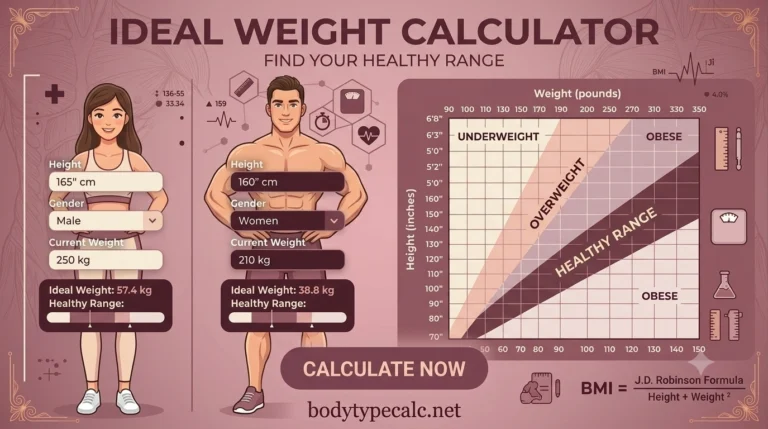
What Is an Ideal Weight Calculator?
This tool uses several well-established medical formulas to estimate a healthy weight range based on your height and gender. Here’s how it works and why these formulas are still used today.
Ideal weight definition
Ideal Body Weight (IBW) is an estimated weight based on height and gender. It was originally developed to help calculate medication dosages rather than define how someone should look.
How the calculator works
The calculator uses your height and gender to calculate your ideal weight with several established formulas, allowing you to compare the results instead of relying on a single estimate.
Why ideal weight matters
IBW is still used in clinical settings, particularly for medication dosing, because some drugs are more accurately calculated using ideal body weight rather than total body weight.
Why it’s only an estimate
These formulas don’t account for muscle mass, body fat, or frame size. As a result, a muscular person may appear “overweight” by IBW standards while still being perfectly healthy.
How to Use the Ideal Weight Calculator
You only need a few basic details to calculate your ideal weight. Here’s what to enter.
What Information Do You Need?
Only a few details are required, while optional information provides additional context for your results. Here’s what each one does.
Gender
Since men and women have different average body compositions, each formula uses separate values for each gender.
Height
Height is the most important factor in every ideal weight formula because taller people naturally have a higher healthy body weight.
Current Weight (Optional)
Entering your current weight lets you compare it with your calculated ideal weight range, although it isn’t required to perform the calculation.
Measurement Unit
Whether you use feet and pounds or centimeters and kilograms, make sure your height and weight are entered in the same measurement system.
How Is Ideal Weight Calculated?
Every major ideal weight formula follows the same basic approach, although the exact values differ. Here’s how they work.
Brief explanation
Each formula starts with a base weight for someone who is 5 feet tall and adds a fixed amount for every inch above that height.
Different medical formulas
Several researchers developed different formulas over the years, so the calculator shows results from each one instead of relying on a single estimate.
Why results may vary slightly
Because each formula is based on different research and assumptions, the results usually vary by only a few pounds instead of matching exactly.
Ideal Weight Formulas
These four formulas are the most commonly used methods for estimating Ideal Body Weight (IBW). Each uses the same 5-foot baseline but applies different starting values and weight increments.
Devine Formula
Male: 50.0 kg + 2.3 kg per inch over 5 feet
Female: 45.5 kg + 2.3 kg per inch over 5 feet
Developed in 1974 for medication dosage calculations, the Devine Formula remains the most widely used ideal weight formula.
Robinson Formula
Male: 52 kg + 1.9 kg per inch over 5 feet
Female: 49 kg + 1.7 kg per inch over 5 feet
Introduced in 1983, the Robinson Formula is a modified version of the Devine formula.
Miller Formula
Male: 56.2 kg + 1.41 kg per inch over 5 feet
Female: 53.1 kg + 1.36 kg per inch over 5 feet
Also introduced in 1983, the Miller Formula uses a higher base weight with a smaller increase for each additional inch of height.
Hamwi Formula
Male: 48.0 kg + 2.7 kg per inch over 5 feet
Female: 45.5 kg + 2.2 kg per inch over 5 feet
Developed in 1964, the Hamwi Formula is the oldest of the four and was originally created for medication dosage calculations.
Each formula is based on different research and population data, which is why the results aren’t identical. Comparing all four formulas provides a more realistic weight range instead of relying on a single target.
Ideal Weight Chart
The chart below shows how ideal weight generally changes with height based on averages from the major medical formulas.
Men
| Height | Ideal Weight (lbs) |
| 5’2″ | 117 to 131 |
| 5’4″ | 126 to 141 |
| 5’6″ | 136 to 151 |
| 5’8″ | 145 to 161 |
| 5’10” | 155 to 171 |
| 6’0″ | 164 to 181 |
| 6’2″ | 174 to 191 |
Women
| Height | Ideal Weight (lbs) |
| 4’10” | 91 to 105 |
| 5’0″ | 100 to 114 |
| 5’2″ | 108 to 122 |
| 5’4″ | 117 to 131 |
| 5’6″ | 125 to 139 |
| 5’8″ | 134 to 148 |
| 5’10” | 142 to 156 |
Healthy Weight Range
Ideal weight and healthy weight are closely related, but they aren’t exactly the same.
Healthy weight vs ideal weight
Ideal weight is calculated using medical formulas based on your height and gender. Healthy weight covers a broader range and considers factors such as BMI, body composition, and overall health.
Why there isn’t one perfect weight
Body composition, frame size, and muscle mass all influence what a healthy weight looks like, so no single formula can be accurate for everyone.
Recommended weight range
Based on the World Health Organization (WHO) healthy BMI range of 18.5 to 24.9, most adults have a healthy weight range rather than one ideal number.
Ideal Weight vs BMI
| Ideal Weight | BMI |
| Based on height and gender | Based on height and weight |
| Gives a specific target figure | Gives a category range |
| Doesn’t factor in current weight | Directly uses current weight |
| Originally built for drug dosing | Used for general health screening |
What BMI measures
BMI compares your current weight with your height and places you into categories such as underweight, healthy weight, overweight, or obesity.
What ideal weight measures
Ideal weight estimates a target weight using only your height and gender, without considering your current body weight.
Ideal Weight vs Body Fat Percentage
These two measurements assess your body in very different ways.
Difference
Ideal weight estimates a target weight based on your height and gender. Body fat percentage measures how much of your current body weight is made up of fat. A body fat calculator provides a much clearer picture of body composition than ideal weight alone.
Ideal Weight vs Lean Body Mass
Both relate to body weight, but they measure very different things.
Difference
Ideal weight is a general estimate based only on your height and gender. Lean body mass measures the weight of everything in your body except fat. A Lean Body Mass Calculator provides a more personalized estimate of your body composition.
Ideal Weight vs Body Type
Body type and ideal weight measure completely different aspects of your body.
Difference
Ideal weight is estimated using your height and gender. Body type describes your body proportions and shape, such as hourglass, pear, or rectangle.
Explain why body shape doesn’t determine ideal weight
Two people can have the same body type but very different healthy weights because body type is based on proportions rather than total body weight. A body type calculator and an ideal weight calculator answer different questions and work best when used together.
Factors That Affect Ideal Weight
Ideal weight isn’t the same for everyone, even at the same height. Several factors can influence what a healthy weight looks like for you.
Age
After the late teens, age has less direct impact on ideal weight, although natural muscle loss over time can slightly lower a healthy weight range.
Gender
Men generally have more muscle mass than women, so ideal weight formulas usually produce higher values for men of the same height.
Muscle mass
More muscle increases body weight at the same height, which is why muscular people may appear “overweight” according to standard IBW formulas.
Body frame size
People with a larger frame naturally weigh more than those with a smaller frame, even at the same height and body fat percentage.
Genetics
Genetics influence body size, bone density, and fat distribution, all of which affect your healthy weight range.
Activity level
Active people often have more muscle and less body fat than sedentary people, which can change what a healthy weight looks like.
How to Reach Your Ideal Weight
If your current weight falls outside the estimated range, these habits can help you reach and maintain a healthier weight.
Healthy eating
A balanced diet built around whole foods supports gradual and sustainable weight management.
Exercise
Regular exercise helps support fat loss, muscle gain, and overall health.
Strength training
Strength training improves body composition by increasing muscle mass, even if your weight changes very little.
Sleep
Getting enough sleep supports healthy hormones, recovery, and long-term weight management.
Consistency
Small, consistent habits usually produce better long-term results than short-term, extreme changes.
Is Ideal Weight Accurate?
Like most health calculators, an Ideal Weight Calculator has both strengths and limitations.
Benefits
It provides a quick reference point based on height and gender and remains useful in clinical settings for medication dosing.
Limitations
These formulas don’t account for muscle mass, body fat percentage, or frame size, so the results may be misleading for athletes and highly muscular individuals.
Why it shouldn’t be the only health measure
Ideal weight works best alongside measures such as body fat percentage, waist-to-hip ratio, and overall fitness instead of being used as the only indicator of health.
Common Ideal Weight Calculation Mistakes
A few simple mistakes can make your results less accurate. Watch for these.
Tips for Maintaining a Healthy Weight
Maintaining a healthy weight over the long term depends on consistent, sustainable habits. Here’s what helps.
Who Should Use an Ideal Weight Calculator?
An Ideal Weight Calculator is useful for many people, although its purpose can vary depending on your goals.
Adults
Most adults can use it as a general reference when setting long-term health and weight goals.
Fitness beginners
Fitness beginners can use it as a simple starting point before exploring more detailed measurements like body fat percentage or FFMI.
Weight-loss users
If you’re trying to lose weight, use it as one reference point rather than a fixed goal.
People planning healthy weight goals
Anyone planning a healthy weight goal can use the estimated range as a guide alongside other health measurements.
Frequently Asked Questions
Conclusion
An ideal weight calculator provides a helpful reference point, not a strict weight you need to reach. Use it as a starting point and combine it with other health measurements for a more complete picture of your overall health. For a more complete understanding of your body, use it alongside a Body Type Calculator, Body Fat Calculator, FFMI Calculator, Waist-to-Hip Ratio Calculator, Body Measurement Calculator, and Figure Calculator.