
Calculate Your Fat-Free Mass Index with Our FFMI Calculator
FFMI (Fat-Free Mass Index) estimates how much fat-free mass you have relative to your height, independent of body fat. This calculator uses your height, weight, and body fat percentage to calculate your FFMI, providing a more useful measure of muscularity than body weight or BMI alone. Below, you’ll learn how the calculator works, how to interpret your FFMI score, and what is generally considered a healthy FFMI.
FFMI Calculator
Enter your height, weight, and body fat percentage to calculate your Fat-Free Mass Index.
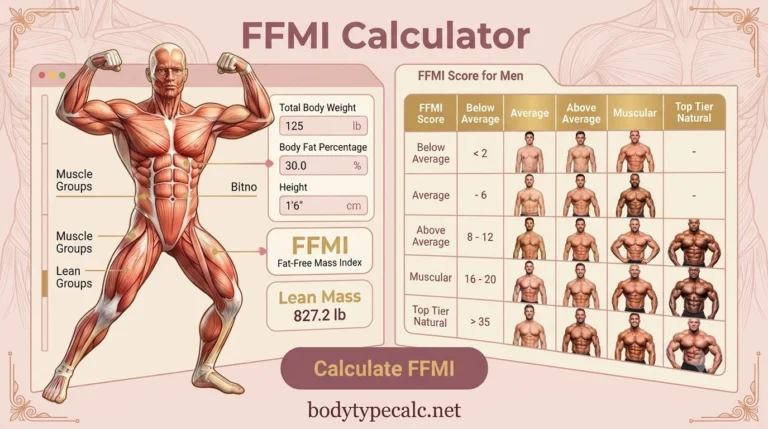
What Is FFMI?
FFMI removes fat from the equation and measures fat-free mass relative to your height. Here’s what it measures and why it’s widely used in strength training.
FFMI definition
Fat-free mass index (FFMI) measures the amount of fat-free mass on your body relative to your height. It’s calculated similarly to BMI, but instead of using total body weight, it uses only fat-free mass, including muscle, bone, organs, and body water.
What Fat-Free Mass Index measures
FFMI measures muscularity in a way that adjusts for height, so a tall person and a short person can be compared fairly. It gives a single score that reflects how much lean tissue someone is carrying.
Why athletes use FFMI
Bodybuilders, strength athletes, and researchers use FFMI because it separates fat-free mass from fat mass, which body weight or BMI alone can’t do.
Why it’s more useful than weight alone
Two people can weigh exactly the same and have completely different amounts of muscle. FFMI highlights those differences, giving a clearer picture of body composition and training progress.
How to Use the FFMI Calculator
Getting your FFMI score takes just a few numbers, most of which you likely already know. Here’s the process.
What Information Do You Need?
FFMI only needs a small set of inputs, but each one plays a specific role in the formula. Here’s what each one is for.
Height
Height is used to adjust the score so people of different sizes can be compared fairly.
Weight
Your total body weight is the starting point used to calculate fat-free mass.
Body Fat Percentage
This number lets the formula calculate exactly how much of your weight is fat-free mass versus fat mass.
Gender
Men and women naturally carry different amounts of muscle and essential fat, so gender changes how the result should be interpreted.
FFMI Formula
FFMI is calculated in a few simple steps using your height, weight, and body fat percentage. Both standard and adjusted FFMI can be calculated.
Standard FFMI Formula
First, fat-free mass is calculated: Fat-Free Mass = Weight (kg) × (1 − Body Fat % ÷ 100)
Then FFMI itself: FFMI = Fat-Free Mass (kg) ÷ Height (m)²
The result is expressed in kilograms per square meter, the same unit style used for BMI.
Adjusted FFMI Formula
Adjusted, or normalized, FFMI corrects for height, since taller people naturally need more total muscle mass to reach the same FFMI score as someone shorter:
Normalized FFMI = FFMI + 6.1 × (1.8 − Height in meters)
This adjustment helps account for height differences, making FFMI comparisons more consistent across individuals. It uses a reference height of 1.8 meters.
How Is FFMI Calculated?
Working through an example makes the formula easier to understand. Here’s how it’s calculated for both a male and female example.
Step-by-step calculation
Male example
A man weighing 75 kg, standing 180 cm tall, with 22% body fat:
- Fat-free mass = 75 × (1 − 0.22) = 58.5 kg
- FFMI = 58.5 ÷ (1.8)² = 18.1
Since his height is close to the 1.8 m reference point, his normalised FFMI remains close to 18.1.
Female example
A woman weighing 60 kg, standing 165 cm tall, with 28% body fat:
- FFMI = 43.2 ÷ (1.65)² = 15.9
- Fat-free mass = 60 × (1 − 0.28) = 43.2 kg
FFMI Chart
These ranges provide a general guide to interpreting FFMI scores. Higher scores become increasingly rare without years of consistent training.
| Category | Men (FFMI) | Women (FFMI) |
| Below Average | Below 18 | Below 15 |
| Average | 18–20 | 15–17 |
| Above Average | 20–22 | 17–18 |
| Excellent | 22–23 | 18–19 |
| Superior | 23–26 | 19–21.5 |
| Rare Natural Range | 26–28 | 21.5–25 |
| Extremely Rare Without Enhancement | Above 28 | Above 25 |
What Is a Good FFMI?
A “good” FFMI depends heavily on training background and goals, but these general bands give a useful reference point.
Very Low
Scores well below average often reflect low muscle mass, which can point to limited training experience or significant muscle loss.
Average
Most untrained or lightly active adults fall into this range, reflecting a typical baseline amount of muscle for their height.
Fit
This range reflects consistent training over time, with noticeably more muscle mass than the general population.
Athletic
Scores in this range usually belong to people who train seriously and consistently, often with several years of dedicated strength work behind them.
Excellent
Reaching this range typically takes years of focused training and represents a genuinely high level of natural muscularity.
Elite
The highest natural FFMI scores are rare and usually seen in competitive athletes or bodybuilders with years of training and favorable genetics.
FFMI vs BMI
The table below compares FFMI and BMI to show how they measure body composition differently.
| FFMI | BMI |
| Uses height, weight, and body fat | Uses only height and weight |
| Separates muscle from fat | Can’t tell muscle from fat |
| Accurate for muscular individuals | Often misclassifies muscular people as overweight |
| Less commonly used | Widely used general screening tool |
What BMI measures
BMI measures total weight relative to height, without distinguishing between muscle, fat, or bone. It works reasonably well as a general population screening tool.
What FFMI measures
FFMI measures only the fat-free portion of body weight relative to height, which makes it far more accurate for people who carry significant muscle mass.
FFMI vs Lean Body Mass
These two numbers are closely related but aren’t quite the same thing.
Difference
Lean body mass is a weight measurement expressed in pounds or kilograms. FFMI adjusts that fat-free mass for height, making it easier to compare between individuals.
Relationship
FFMI is essentially lean body mass normalized against height, using the same underlying calculation as a lean body mass calculator, just expressed differently.
FFMI vs Body Fat Percentage
Both numbers come from the same core inputs but describe different things.
Difference
Body fat percentage tells you what portion of your body weight is fat. FFMI tells you how much fat-free mass you carry relative to your height.
Which one measures what
Body fat percentage is about the composition ratio. FFMI is about actual muscularity adjusted for frame size. A body fat calculator is usually the first step, since its result feeds directly into the FFMI formula.
Why FFMI Matters
FFMI gives a specific kind of insight that general weight tracking can’t offer. Here’s where it’s most useful.
Muscle-building progress
FFMI helps show whether weight gained during training is primarily fat-free mass rather than just an increase in body weight.
Natural bodybuilding
FFMI is widely used as a rough screening tool in natural bodybuilding, since scores above certain thresholds are extremely difficult to reach without external assistance.
Fitness assessment
Coaches and trainers use FFMI to get a clearer sense of a client’s actual muscularity beyond just height and weight.
Training goals
Knowing your current FFMI helps you set realistic muscle-building goals based on your current physique.
Nutrition planning
FFMI can help guide calorie and protein targets, since more fat-free mass generally requires more nutritional support to maintain and grow.
Factors That Affect FFMI
FFMI isn’t static. Several factors influence where your score lands.
Muscle mass
More muscle directly raises FFMI, since muscle makes up the largest part of fat-free mass for most people.
Body fat
Lower body fat, at the same total weight, increases fat-free mass and therefore raises FFMI.
Age
Muscle mass naturally declines with age unless actively maintained, which tends to lower FFMI over time.
Genetics
Natural muscle-building potential varies between individuals, affecting how high FFMI can realistically increase.
Training
Consistent resistance training over months and years is the primary driver of long-term FFMI increases.
Diet
Adequate calories and protein support muscle growth, while chronic undereating makes building fat-free mass much harder.
How to Improve FFMI
Raising your FFMI comes down to building muscle while keeping fat gain in check. Here’s what actually moves the number.
Is FFMI Accurate?
FFMI is a useful estimate, but like any formula based on limited inputs, it has both strengths and limitations worth understanding.
Advantages
FFMI accounts for height and body fat, making it more useful than BMI for people who train seriously or carry above-average muscle mass.
Limitations
The formula still relies on an estimated body fat percentage, so accuracy depends heavily on how that number was obtained.
When results may vary
Very tall or very short individuals, as well as people with unusual body proportions, may see results that differ from general classification ranges.
How to Improve FFMI
A few small input errors can shift your FFMI score more than expected. Watch out for these.
Tips for Better Results
A few consistent habits can make your FFMI tracking more reliable over time.
Who Should Use an FFMI Calculator?
FFMI is useful beyond competitive bodybuilding. Here are the people who may benefit most from tracking it.
Bodybuilders
Bodybuilders use FFMI to track muscle growth phases and compare progress against natural benchmarks.
Gym beginners
Beginners can use FFMI as a starting reference point to track how training changes their body composition over time.
Athletes
Athletes in strength or power sports often use FFMI to monitor whether training is building functional muscle mass.
People tracking muscle gain
Anyone in a muscle-building phase can use FFMI to track whether gained weight is coming from lean tissue rather than fat.
Weight-loss users
People losing weight can use FFMI to check that fat-free mass is being preserved rather than lost alongside fat.
Frequently Asked Questions
Conclusion
FFMI gives you a clearer picture of your muscularity than weight or BMI alone, especially if you train regularly. Track it periodically, use an accurate body fat percentage as your input, and focus on long-term trends rather than any single reading. For a complete picture of your body composition, pair FFMI with a body type calculator, and body measurement calculator.