
Calculate Your Lean Body Mass with Our Free LBM Calculator
Lean body mass (LBM) is the weight of everything in your body except fat. This calculator uses your height, weight, gender, and, if available, body fat percentage to estimate your lean body mass using several established formulas. This guide explains how the calculator works, the formulas it uses, and what your lean body mass means for your fitness and overall health.
Lean Body Mass Calculator
Enter your gender, height, and weight to estimate your lean body mass.
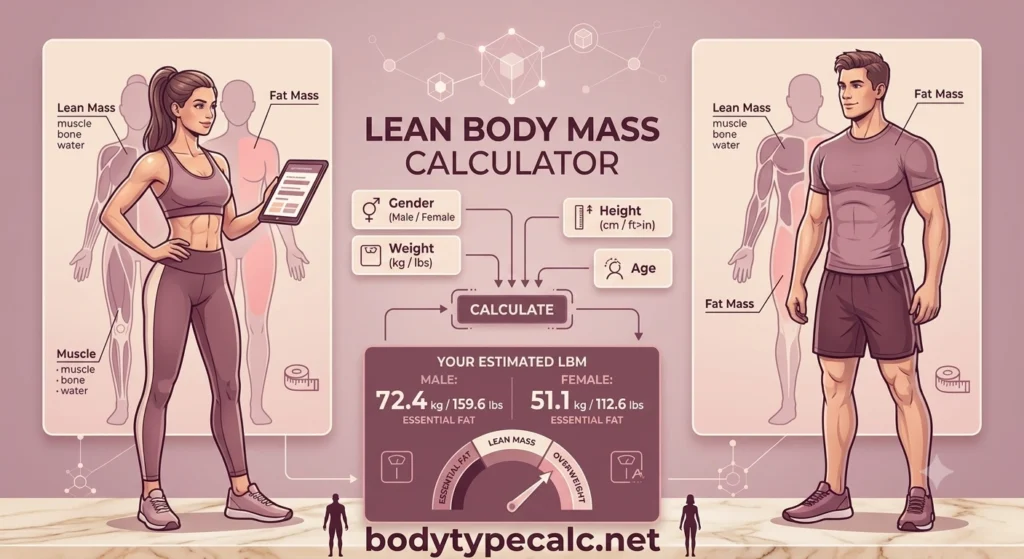
What Is Lean Body Mass?
Lean body mass gives you a clearer picture of your body composition than body weight alone. Here’s what it includes and why it matters.
Lean body mass definition
Lean body mass (LBM) is your total body weight minus your body fat. It’s the weight of everything in your body that isn’t fat.
What counts as lean mass
Lean body mass includes muscle, bone, water, organs, blood, skin, tendons, and ligaments. In simple terms, it includes everything except stored body fat.
Lean body mass vs body weight
Total body weight includes both fat and lean mass. Lean body mass excludes fat, so two people with the same body weight can have very different LBM values depending on their body fat percentage.
Why it matters
LBM gives a more accurate picture of body composition than weight alone. It’s commonly used for fitness tracking, nutrition planning, and medication dosing, where lean body mass may be more useful than total body weight.
How to Use the Lean Body Mass Calculator
You only need a few basic details to calculate your lean body mass. Enter the following information:
View results: The calculator displays your estimated lean body mass and may also show results from multiple formulas for comparison.
What Information Do You Need?
You only need a few basic details to calculate your lean body mass. Here’s what each input is used for.
Gender
Men and women have different average body compositions, so each formula uses separate equations for each gender.
Height
Height is included in every formula because taller people generally carry more lean body mass.
Weight
Your current body weight is a required input for every lean body mass formula.
Body Fat Percentage (if available)
If you know your body fat percentage, the calculator can estimate your lean body mass directly instead of relying only on predictive formulas.
Lean Body Mass Formula
Several formulas can estimate lean body mass, each developed from different research and using slightly different calculation methods. The formulas below use weight in kilograms and height in centimeters.
Boer Formula
The Boer Formula is one of the most widely used methods for estimating lean body mass.
James Formula
The James Formula uses a different relationship between weight and height, which can produce slightly different results than the Boer Formula.
Hume Formula
The Hume Formula estimates lean body mass using only height and weight.
This calculator uses the Boer Formula by default while also showing results from the James and Hume formulas for comparison.
If you already know your body fat percentage, lean body mass can also be calculated directly:
Lean Body Mass = Body Weight − (Body Weight × Body Fat %)
How Is Lean Body Mass Calculated?
Here’s how the Boer Formula works with real numbers. Below are examples for both men and women.
Male example
A man weighing 80 kg at 180 cm tall: LBM = 0.407 × 80 + 0.267 × 180 − 19.2 LBM = 32.56 + 48.06 − 19.2 = 61.4 kg
Female example
A woman weighing 65 kg at 165 cm tall: LBM = 0.252 × 65 + 0.473 × 165 − 48.3 LBM = 16.38 + 78.05 − 48.3 = 46.1 kg
Lean Body Mass Chart for Men and Women
These values provide a general estimate of lean body mass by age. Your actual result may vary depending on body size, muscle mass, and activity level.
| Age | Men | Women |
| 20–29 | 140–155 lbs | 95–108 lbs |
| 30–39 | 138–152 lbs | 94–106 lbs |
| 40–49 | 135–148 lbs | 92–104 lbs |
| 50–59 | 130–144 lbs | 89–100 lbs |
| 60+ | 125–138 lbs | 86–96 lbs |
Lean Body Mass vs Body Fat
Lean body mass and body fat measure different parts of your total body weight.
Difference
Lean body mass is everything in your body that isn’t fat. Body fat represents the fat stored in your body. Together, lean body mass and body fat make up your total body weight.
Which measures muscle
Lean body mass includes muscle, but it also includes bone, organs, water, and other non-fat tissues.
Which includes organs
Lean body mass includes organ weight. Body fat percentage measures only the fat portion of your body, not your organs or other lean tissues.
Relationship
As your body fat percentage decreases, lean body mass makes up a greater percentage of your total body weight, even if the number on the scale stays the same.
Lean Body Mass vs Fat-Free Mass
Lean body mass and fat-free mass are often used interchangeably, although there’s a small technical difference between them.
Difference
Fat-free mass excludes all body fat, including essential fat. Lean body mass subtracts most fat but still includes the small amount of essential fat found within organs.
Are they the same?
For most practical purposes, yes. The numerical difference is small.
When they’re different
The difference is typically 2–3% in men and 5–12% in women because women naturally carry more essential fat in their organs and tissues.
Lean Body Mass vs Muscle Mass
Lean body mass and muscle mass are closely related, but they aren’t the same thing.
Difference
Muscle mass refers only to the muscles in your body. Lean body mass includes muscle along with all other non-fat tissues.
Muscle
Muscle is typically the largest component of lean body mass, especially in active individuals.
Bone
Bone contributes to lean body mass even though it isn’t muscle tissue.
Water
Water makes up a significant portion of lean body mass because muscle tissue is mostly water.
Organs
Organs are also included in lean body mass, along with the small amount of essential fat they naturally contain.
Why Lean Body Mass Matters
Tracking lean body mass provides insights that body weight alone cannot. Here are some of its main benefits.
Better fitness tracking
Lean body mass helps you see whether changes in weight come from muscle or body fat.
Weight loss
Monitoring lean body mass during weight loss helps you preserve muscle while reducing body fat.
Nutrition
Protein requirements and calorie needs are often estimated more accurately using lean body mass instead of total body weight.
Strength training
Lean body mass is a useful way to track muscle-building progress from training and nutrition.
Health assessment
Some medical assessments and medication doses use lean body mass because it better reflects metabolically active tissue than total body weight.
Factors That Affect Lean Body Mass
Lean body mass changes over time. Several factors influence how much lean body mass you have.
Age
Lean body mass gradually declines with age unless it’s maintained through regular strength training and physical activity.
Gender
Men generally have more lean body mass than women because of differences in muscle mass and hormone levels.
Exercise
Regular resistance training is one of the most effective ways to build and maintain lean body mass.
Protein intake
Getting enough protein supports muscle growth and repair.
Hormones
Hormones such as testosterone and growth hormone influence how easily your body builds and maintains muscle.
Genetics
Genetics affect your natural muscle-building potential and overall body composition.
How to Increase Lean Body Mass
Increasing lean body mass requires consistent training, nutrition, and recovery. Here are the habits that make the biggest difference.
Strength training
Strength training is the most effective way to increase muscle mass, the largest component of lean body mass.
Protein
Eating enough protein throughout the day helps support muscle repair and growth.
Sleep
Quality sleep supports muscle recovery and growth, making it an important part of building lean body mass.
Progressive overload
Gradually increasing the weight, repetitions, or training intensity encourages continued muscle growth.
Recovery
Recovery time between workouts allows muscles to repair, rebuild, and grow stronger.
Healthy Lean Body Mass Range
Lean body mass varies from person to person because it’s influenced by height, body size, and muscle mass. For that reason, it’s often expressed as a percentage of total body weight instead of a single target value.
Men
A healthy lean body mass for men generally ranges from 75% to 90% of total body weight.
Women
A healthy lean body mass for women generally ranges from 68% to 85% of total body weight.
General reference values
These ranges vary based on age, activity level, and individual body composition, so they work best as general reference points rather than strict targets.
Common Lean Body Mass Calculation Mistakes
Small mistakes can easily affect your result. Avoid these common errors for a more accurate lean body mass estimate.
Tips for Accurate Results
Although both measurements use your height and weight, they measure very different aspects of your body.
Lean Body Mass vs BMI
These numbers give a general sense of typical lean body mass by age, though individual results vary a lot based on activity level and body size.
| Lean Body Mass | BMI |
| Uses weight, height, and body fat | Uses only height and weight |
| Shows composition, not just size | Doesn’t separate muscle from fat |
| Better for tracking muscle change | Quick general screening tool |
Lean Body Mass vs Body Fat Calculator
| Lean Body Mass Calculator | Body Fat Calculator |
| Estimates non-fat body weight | Estimates fat as a percentage |
| Useful for muscle and nutrition tracking | Useful for fat loss tracking |
| Often uses body fat % as an input | Produces the body fat % used elsewhere |
These two tools complement each other well. Once you know your body fat percentage, you can calculate your lean body mass more accurately instead of relying only on estimation formulas.
Lean Body Mass vs Body Type Calculator
A Body Type Calculator and a Lean Body Mass Calculator both relate to body composition, but they measure different things.
Explain difference
A Body Type Calculator evaluates your overall body build, proportions, and sometimes your frame size. A Lean Body Mass Calculator estimates the weight of everything in your body except body fat. One helps describe your overall body build, while the other calculates a specific lean body mass value.
Lean Body Mass vs Ideal Weight
An Ideal Weight Calculator estimates a healthy weight range based on your height and gender. A Lean Body Mass Calculator shows how much of your current body weight comes from lean tissue, regardless of whether your weight falls within the ideal range. Two people can have the same ideal weight but very different lean body mass and body fat levels, which is why both measurements provide valuable health insights.
Frequently Asked Questions
Conclusion
Lean body mass provides a clearer picture of your body composition than body weight alone. Whether you’re tracking muscle gain, managing fat loss, or simply monitoring your fitness, checking your lean body mass regularly provides a more meaningful way to measure progress. For a more complete picture of your body composition, use it alongside a body type calculator, body measurement calculator, and waist-to-hip ratio calculator.