Body Fat Calculator | Calculate Body Fat Percentage (Men & Women)
Use our Body Fat Calculator to estimate your body fat percentage using simple body measurements. For the most accurate results, measure to the nearest 1/4 inch (0.5 cm) and use the same unit throughout. The calculator uses the U.S. Navy Method and also provides a BMI-based estimate for comparison. Enter your measurements in inches or centimeters to instantly see your body fat percentage, body fat category, fat mass, and lean body mass.
Use this converter to convert to the unit accepted by the calculator
Result
| Body Fat (U.S. Navy Method) | — |
| Body Fat Category | — |
| Body Fat Mass | — |
| Lean Body Mass | — |
| Ideal Body Fat for Given Age (Jackson & Pollock) | — |
| Body Fat to Lose to Reach Ideal | — |
| Body Fat (BMI method) | — |
What Is a Body Fat Calculator?
This tool goes beyond a simple weight check by estimating what portion of your body is actually fat. Here’s what it calculates and why it’s useful.
What it calculates
A body fat calculator estimates what percentage of your total body weight is made up of fat, using measurements like waist, neck, height, and weight rather than weight alone.
Why body fat percentage matters
Body fat percentage gives a much clearer health picture than weight or BMI on their own. Two people at the same weight can have very different amounts of fat versus muscle, and that difference matters for health risk.
Who should use it
Anyone who wants a better sense of their body composition, whether for general health, fitness tracking, or athletic training, can use this calculator.
Body fat vs body weight
Body weight includes everything: fat, muscle, bone, and water. Body composition helps separate these components, showing how much of your weight comes from fat versus lean tissue. That’s why someone with more muscle can weigh more while still having a low body fat level.
How to Use the Body Fat Calculator
Filling in the calculator takes a few basic details plus a couple of tape measurements. Here’s every field you’ll need to complete.
Select gender
Choose male or female, since the formula and healthy ranges differ between the two.
Enter age
Age affects the ideal body fat range used for comparison.
Enter height
Height is required for both the Navy method and the BMI method.
Enter weight
Your current body weight is used alongside height for the BMI-based estimate.
Enter waist measurement
Waist measurement is one of the key inputs for the Navy method calculation.
Enter neck measurement
Neck measurement is used in the Navy method formula for both men and women.
Enter hip measurement (women)
Women also need a hip measurement, since it’s part of the female-specific Navy method formula.
Choose inches or centimeters
Pick whichever unit works for you; just keep every measurement consistent.
Calculate body fat percentage
Once every field is filled in, the calculator returns your estimated body fat percentage along with your category.
What Measurements Do You Need?
The exact measurements needed depend on gender, since the Navy method formula differs slightly for men and women. Here’s what each one involves.
Height
Your height is used in both the Navy method and BMI method formulas.
Weight
Your weight is required for the BMI-based estimate and for working out fat mass in pounds or kilograms.
Neck
Neck circumference is measured just below the larynx and used in the Navy method formula.
Waist
Waist is measured at the navel for men and at the narrowest point for women.
Hips (Women Only)
Hip measurement is taken at the widest point and used specifically in the female version of the Navy method formula.
How to Measure Body Fat Correctly
Where and how you place the tape matters just as much as the numbers themselves. Here’s how to measure each area correctly.
How to Measure Your Neck
Wrap the tape just below your larynx, letting it slope slightly downward toward the front. Avoid flaring your neck outward while measuring.
How to Measure Your Waist
For men, measure at the navel. For women, measure at the narrowest point of the torso. Don’t pull your stomach in while measuring.
How to Measure Your Hips
Wrap the tape around the widest part of your hips and seat, keeping it level all the way around.
Tips for Accurate Measurements
Use a soft tape measure, stand naturally, and measure each spot two or three times to make sure your numbers are consistent.
Understanding Your Body Fat Result
Your body fat result is more useful when compared with healthy ranges for your age and gender. Here’s how to understand what your result means.
What Your Result Means
Your body fat percentage shows how much of your total body weight is made up of fat, while the rest consists of muscle, bone, organs, and body water.
Healthy vs unhealthy ranges
Healthy ranges vary by gender and change gradually with age. Results that fall well above or below the recommended range may increase health risks and should be discussed with a healthcare professional.
Why age and gender matter
Men and women naturally have different amounts of essential fat, and body fat tends to increase gradually with age. That’s why healthy ranges are different for each group.
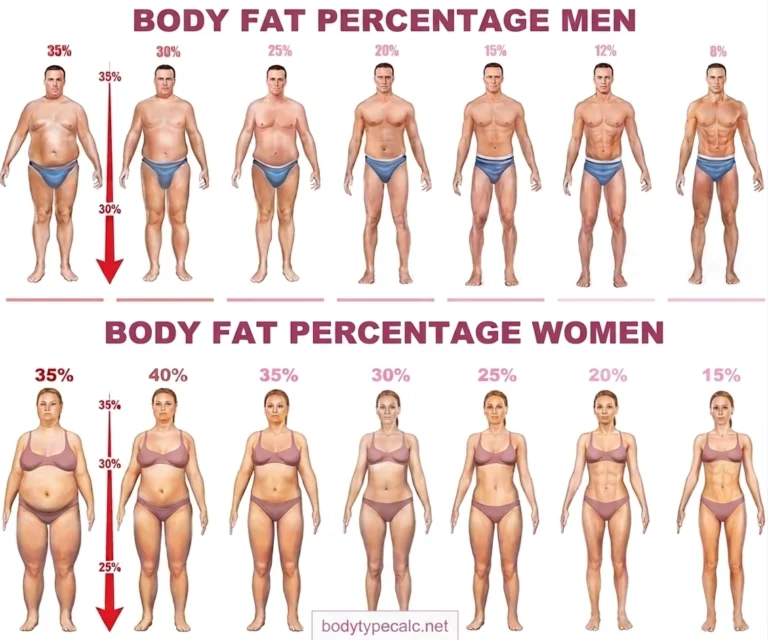
Body Fat Categories for Men and Women
| Category | Men | Women |
| Essential Fat | 2 to 5% | 10 to 13% |
| Athletes | 6 to 13% | 14 to 20% |
| Fitness | 14 to 17% | 21 to 24% |
| Average | 18 to 24% | 25 to 31% |
| Obese | 25%+ | 32%+ |
Ideal Body Fat Percentage by Age
Beyond the general categories, Jackson and Pollock developed age-based healthy body fat ranges. These values provide a more personalized reference than using a single range for all adults.
| Age | Men | Women |
| 20 | 8.5% | 17.7% |
| 25 | 10.5% | 18.4% |
| 30 | 12.7% | 19.3% |
| 35 | 13.7% | 21.5% |
| 40 | 15.3% | 22.2% |
| 45 | 16.4% | 22.9% |
| 50 | 18.9% | 25.2% |
| 55 | 20.9% | 26.3% |
This calculator uses these figures to show how your own result compares to the ideal for your specific age, along with how much fat you’d need to lose to reach it.
Body Fat Categories Explained
Each category on the chart reflects a different level of body composition, from essential fat to obesity. Here’s what each category means.
Essential Fat
The minimum amount of fat needed for basic body functions, including hormone production and organ protection. Going below this range for extended periods can affect health.
Athletes
Common among people with high levels of physical training, where visible muscle definition is supported by a low body fat level.
Fitness
Represents a lean, healthy body composition without reaching the very low levels often seen in competitive athletes.
Average
The most common range for generally healthy adults who aren’t specifically training for athletic performance.
Obesity
A body fat level high enough to increase the risk of health conditions such as heart disease and type 2 diabetes.
Essential Fat vs Storage Fat
Body fat isn’t just one single thing. It splits into two distinct types, and understanding the difference explains why some fat is necessary while excess amounts are not.
Essential fat
Essential fat is the minimum amount your body needs to function properly. It supports hormone production, protects vital organs, and plays an important role in reproductive health. Women naturally carry more essential fat than men, typically 10–13% compared with 2–5% for men.
Storage fat
Storage fat builds up beyond the essential amount and is what most people mean when they talk about body fat. It exists in two forms: subcutaneous fat, which sits just beneath the skin, and visceral fat, which surrounds the internal organs.
Why visceral fat matters more
Visceral fat is associated with more health risks than subcutaneous fat, even when overall body fat levels are similar. Because it surrounds the internal organs, it has a greater impact on hormone balance and metabolic health.
Health Risks of Excess Body Fat
Carrying too much body fat, especially around the abdomen, can increase the risk of several long-term health conditions. While a healthy amount of fat is essential for normal body function, excess visceral fat is associated with a higher risk of heart disease, type 2 diabetes, high blood pressure, and stroke. Understanding your body fat percentage can help you monitor your body composition and make informed decisions about your overall health.
Body Fat Categories Explained
This calculator uses the U.S. Navy Method to estimate body fat percentage. It’s a simple, equipment-free approach that relies on a few body measurements.
What is the Navy Method?
The Navy method estimates body fat percentage using waist, neck, height, and, for women, hip measurements. It was developed at the Naval Health Research Center in the 1980s as a fast, equipment-free way to estimate body fat.
Why it is widely used
It only requires a tape measure, no special equipment, which makes it accessible and quick compared to lab-based methods.
Required measurements
Height, neck, and waist for men. Height, neck, waist, and hips for women.
Accuracy
It’s a solid estimate for most people, though it can be less precise for those with unusual body proportions or very high muscle mass.
Body vs BMI Fat Percentage
| Body Fat % | BMI |
| Uses body measurements | Uses height and weight |
| Better reflects body composition | Doesn’t separate muscle from fat |
| More accurate estimate | Quick estimate |
How to Calculate Body Fat Percentage
Two different formulas feed into this calculator, each using a slightly different set of measurements. Here’s how each one works.
U.S. Navy Formula
The U.S. Navy Formula calculates body fat using your waist, neck, and height measurements. For women, hip measurement is also included. Simply enter your measurements into the calculator to get your result instantly.
Fat mass and lean mass
Once you have your body fat result, the calculator also estimates two additional values:
Fat Mass = Body Fat % × Weight
Lean Mass = Weight − Fat Mass
Fat mass tells you how many pounds or kilograms of your body are fat. Lean mass covers everything else, muscle, bone, organs, and water.
BMI Formula
The BMI Formula estimates body fat percentage using your BMI and age. Although it is less detailed than the U.S. Navy Method, it provides a useful estimate.
What Is a Healthy Body Fat Percentage?
Healthy ranges aren’t fixed numbers. They shift by gender and gradually by age as well.
Healthy ranges for men
Generally between 8% and 24%, depending on age and fitness level.
Healthy ranges for women
Generally between 21% and 31%, depending on age and fitness level.
Why ranges change with age
As people age, body fat tends to increase gradually even without weight gain, so the healthy range shifts slightly higher over time.
Factors That Affect Body Fat Percentage
How to Reduce Body Fat
Lowering body fat comes down to a handful of consistent habits rather than any single quick fix. Here’s what actually makes a difference.
Create a calorie deficit
Consuming fewer calories than you burn is the basic requirement for losing body fat over time. A calorie calculator can help estimate your daily target.
Strength training
Building and maintaining muscle helps improve body composition, even when the scale doesn’t move much.
Cardio
Regular cardio supports overall body fat loss and cardiovascular health alongside strength work.
High-protein diet
Adequate protein helps preserve muscle mass while you’re in a calorie deficit, making fat loss more effective.
Sleep
Poor sleep affects hormones that regulate hunger and can make fat loss more difficult over time.
Consistency
Small, steady habits maintained over months tend to outperform short bursts of extreme effort.
Common Mistakes When Measuring Body Fat
Body Fat Percentage vs BMI
Both numbers have a place, but they answer slightly different questions. Here’s when each one is the better fit.
Which is better?
Neither is universally better. Body fat percentage gives a more direct look at composition, while BMI is faster and needs fewer measurements.
When to use each
Use BMI for a quick, general check, especially when comparing against population level health data. Use body fat measurements when you want a clearer sense of muscle versus fat, particularly if you’re active or building muscle. Pairing it with an ideal weight calculator or a body type calculator can round out the picture further.
Frequently Asked Questions
Conclusion
A body fat calculator gives you a more complete picture than weight or BMI alone, especially if you’re tracking fitness progress or general health. Measure carefully, use the Navy method for a closer estimate, and check your results against the BMI method as a second reference point. For a fuller view of your body composition, pair this with a waist to hip ratio calculator or body measurement calculator to see how your numbers connect.