
Waist to Hip Ratio Calculator | Calculate Your WHR
Your waist-to-hip ratio (WHR) is a simple measurement that shows how your body carries weight. Unlike the number on a scale, it focuses on where body fat is distributed rather than how much you weigh. It’s quick to calculate, doesn’t need any special equipment beyond a tape measure, and connects directly to both your body shape and a widely used health screening measure.
Enter your waist and hip measurements below to calculate your WHR instantly. You’ll also see what it means for your body proportions and how it compares with standard health risk ranges.
Waist to Hip Ratio Calculator
Enter your waist and hip measurements to calculate your waist-to-hip ratio instantly.
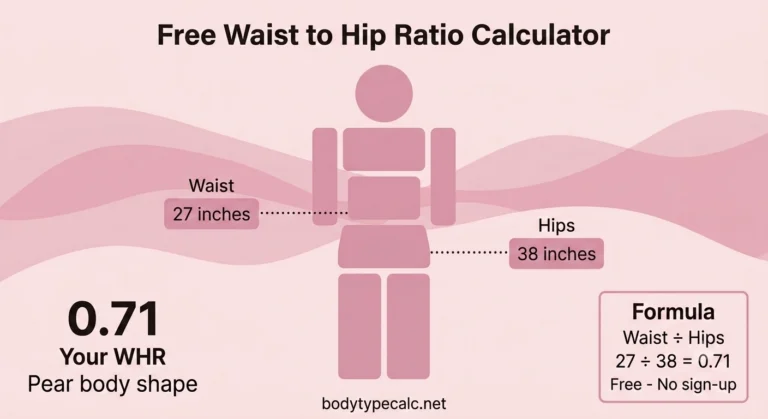
What Is Waist-to-Hip Ratio (WHR)?
Waist-to-hip ratio (WHR) compares your waist measurement with your hip measurement to estimate how body fat is distributed. It’s commonly used to assess health risk and can also provide a general idea of your body shape.
What WHR means
Waist-to-hip ratio (WHR) compares the size of your waist to the size of your hips. You get it by dividing your waist measurement by your hip measurement. The result is a simple number, usually somewhere between 0.60 and 1.10.
Why it matters
WHR is used as a quick screening number for fat distribution. A higher ratio usually means more fat is stored around the waist. A lower ratio means the hips are wider relative to the waist. This pattern matters because where fat is stored on the body is linked to health risk, not just how much fat a person has.
WHR vs body shape
Your WHR can provide a general indication of your body shape. A small waist compared to the hips often points to an hourglass or pear shape. A waist that’s close in size to the hips often points to an apple or rectangle shape. But WHR only looks at two measurements, so it can’t give you the full picture on its own.
WHR vs health
Health organizations use WHR as a screening tool to assess abdominal fat distribution. It doesn’t diagnose anything by itself, but a high WHR is treated as a signal worth paying attention to, especially alongside other factors like blood pressure and blood sugar.
How to Calculate Your Waist-to-Hip Ratio
Your waist-to-hip ratio (WHR) is calculated by dividing your waist measurement by your hip measurement. It’s a simple way to understand your body proportions and fat distribution.
Step 1: Measure your waist
Wrap a soft tape measure around the narrowest part of your natural waist — this is usually about an inch above your belly button. Stand relaxed, breathe normally, and don’t pull your stomach in.
Step 2: Measure your hips
Wrap the tape around the fullest part of your hips and seat, keeping it level all the way around. Keep your feet together while you measure.
Step 3: Divide waist by hips
Take your waist number and divide it by your hip number. Both measurements need to be in the same unit—either both in inches or both in centimeters.
Example (inches & cm)
Waist-to-Hip Ratio Formula
WHR = Waist Circumference ÷ Hip Circumference
Formula explanation
The formula uses only two measurements. As long as your waist and hip measurements are in the same unit, simply divide your waist by your hips to calculate your WHR.
Inches example
Waist = 29 inches, Hips = 38 inches
WHR = 29 ÷ 38 = 0.76
Centimeters example
Waist = 74 cm, Hips = 97 cm,
WHR = 74 ÷ 97 = 0.76
Waist-to-Hip Ratio Chart
Women WHR Chart
| Category | WHR Range |
| Low Risk | 0.80 or below |
| Moderate Risk | 0.81 – 0.85 |
| High Risk | Above 0.85 |
Men WHR Chart
| Category | WHR Range |
| Low Risk | 0.90 or below |
| Moderate Risk | 0.91 – 0.95 |
| High Risk | Above 0.95 |
These ranges are based on the general guidance from the World Health Organization (WHO), which uses 0.85 as the abdominal obesity cutoff for women and 0.90 for men. The moderate range is included to make the results easier to understand, since not everyone falls neatly into the low- or high-risk categories.
What Is a Healthy Waist-to-Hip Ratio?
A healthy waist-to-hip ratio (WHR) indicates that your waist and hip measurements fall within the generally recommended range.
Healthy range for women
A WHR of 0.80 or below is generally considered healthy for women. A WHR of 0.70 is often cited as a balanced ratio, but it isn’t a requirement for good health. It’s simply a commonly referenced value.
Healthy range for men
For men, a WHR of 0.90 or below is generally considered healthy. Men naturally tend to carry a higher ratio than women because of differences in typical fat distribution.
WHO guideline
The World Health Organization lists WHR above 0.85 for women and above 0.90 for men as markers of abdominal obesity. These numbers come from a 2008 WHO report and are still widely referenced today.
Risk categories
How to Measure Your Waist Correctly
An accurate waist measurement helps ensure reliable WHR results.
Natural waist
Your natural waist is the narrowest part of your torso, usually just above your belly button and below your rib cage. It’s not the same as where your pants sit.
Common mistakes
Measuring tips
Stand up straight, breathe out normally, and keep the tape snug without pulling it tight. Measure over bare skin or thin clothing for the most accurate result.
How to Measure Your Hips Correctly
Fullest part of hips
Measure around the fullest part of your hips and seat, usually 7 to 9 inches below your natural waist.
Tape position
Keep the tape parallel to the floor the entire way around your body. If the tape tilts up or down at the back, your measurement won’t be accurate.
Common mistakes
Waist vs High Hip vs Hip Measurements
Difference between all three:
Which measurement does WHR use?
Waist-to-hip ratio (WHR) uses only your waist and full hip measurements. The high hip measurement is useful for clothing fit and body shape analysis, but it isn’t included in the WHR formula.
Waist-to-Hip Ratio and Body Shape
Different body shapes often have different waist-to-hip ratio ranges.
Which body shapes usually have low or high WHR?
A lower WHR is most common in hourglass and pear body shapes, while a higher WHR is more common in apple body shapes. Rectangle body shapes usually fall somewhere in between.
WHR alone can’t determine your body shape. It doesn’t account for your shoulders, bust, or chest measurements, so two people with the same WHR can still have completely different body shapes. For a complete shape result, WHR should be paired with other body measurements.
Waist-to-Hip Ratio vs BMI
| Metric | WHR | BMI |
| What it measures | Fat distribution | Overall weight relative to height |
| Shows where fat is stored | Yes | No |
| Needs height and weight | No | Yes |
| Best used for | Abdominal fat screening | General weight category |
WHR and BMI measure different aspects of body composition, so they’re best used together rather than as alternatives. BMI estimates whether your weight is appropriate for your height, but it doesn’t show how your body fat is distributed. WHR complements BMI by showing how body fat is distributed, which is why the two measurements are often used together.
Waist-to-Hip Ratio vs Waist-to-Height Ratio
Difference
The waist-to-hip ratio compares your waist to your hips. The waist-to-height ratio compares your waist to your total height. Both are used as screening tools for central fat, but they measure the relationship differently.
Which is better?
Neither measurement is universally better. WHR is more useful when you want to track how your waist compares to your hip shape. The waist-to-height ratio is more useful when you want a single number that adjusts for how tall or short someone is.
When to use each
Use WHR when you’re interested in body shape and proportion. Use the waist-to-height ratio when you want a simple assessment that takes your height into account.
Factors That Can Affect Your WHR
How to Improve Your Waist-to-Hip Ratio
Nutrition
Focus on whole foods and enough protein to keep hunger in check. Cutting back on refined carbs, added sugar, and alcohol tends to help the waist measurement specifically.
Exercise
Aim for at least 150 minutes of moderate physical activity each week to support overall fat loss and improve body composition.
Strength training
Strength training two to four times a week helps maintain muscle while reducing body fat, which can improve your WHR over time.
Fat loss
There’s no way to lose fat from just one spot. Overall fat loss through diet and activity is what actually improves WHR over time.
Lifestyle habits
Sleep quality, stress levels, and consistency matter as much as diet and exercise. Getting enough sleep and managing stress can support healthy eating habits and long-term weight management.
Common WHR Measurement Mistakes
Frequently Asked Questions
Conclusion
Your waist-to-hip ratio (WHR) is a quick and simple way to understand how your body stores fat. While it isn’t a substitute for a medical checkup or a complete body shape assessment, it provides a useful measurement to monitor over time.
Measure carefully, use the same method each time, and combine your WHR with other body measurements for a more complete picture of your body proportions and overall health.